
As previously mentioned in another article (“Announcement from Japan Customs | Mandatory to Use ACP in Many Cases – Attorney for Customs Procedures”), from October 2023, overseas sellers, especially those on e-commerce platforms like Amazon, Rakuten, and Shopify, are now required to utilize ACP and become the Importer of Record (IOR) themselves. Therefore, schemes involving designating other Japanese corporations as the IOR are no longer feasible. Despite clear directives to this effect, we observe certain IOR businesses providing unauthorized IOR services.
The prevalence of such questionable practices necessitates this article as a cautionary note. Sellers operating in Japan must strive to understand and comply with the correct legal framework and avoid unnecessary penalties.
Problematic Practices – Violation of Customs Laws
There are instances where transactions seem to exist between overseas businesses and Japanese IORs (who are merely importers in name), with manipulated documents like invoices reflecting undervalued declared prices for customs clearance. In reality, these goods are not directly shipped to fulfillment centers like Amazon but temporarily stored in domestic warehouses. Here, they are labeled before being sent to the final fulfillment destination. This scheme aims to avoid detection by customs as e-commerce products. Such actions are illegal and not in compliance with the law, and I strongly urge an immediate cessation of these practices.
Importing through illegal schemes often leads to undervalued import declarations. Even if customs clearance is initially granted, subsequent Post Clearance Audit by customs can lead to substantial penalties. Legally, the IOR is liable for these payments, which can lead to disputes between overseas sellers and IOR businesses. Typically, the financial burden of import duties and taxes falls on the overseas sellers, making conflicts predictable.
Both the uninformed overseas businesses using these illegal schemes and the IOR operators bear responsibility.
Observing extremely low prices for products by overseas sellers on e-commerce platforms like Amazon often gives an impression of an unfair competitive environment. Legitimate overseas businesses pay appropriate taxes and add these costs to their selling prices, putting them at a disadvantage against sellers who avoid proper tax payments. This unfairness is precisely why the customs system was revised in October 2023.
For businesses with low compliance awareness, the issues likely extend beyond just declared values. Often, they might also be non-compliant with intellectual property laws and other regulations.


Concerns Over Cost Impact of Customs Valuation/Import Declarations
When overseas sellers import goods for e-commerce into Japan, whether through ACP or as another IOR company, there is no “import transaction” with a Japanese buyer, leading to the exceptional determination method for declared import values, typically based on the domestic selling price.
There are concerns about high valuation leading to excessive duties and taxes. However, this is a determination method based on the Customs Tariff Law, which must be adhered to. The cost impact of the valuation is not as significant as often feared.
The taxes on import are mainly customs duties and consumption tax. Japan’s import tariffs are relatively low on a global scale, and many industrial products are duty-free. As for consumption tax, which is a uniform 10%, it is an indirect tax borne by the final consumer, not a cost for the overseas seller. Taxable businesses regularly file consumption tax returns to the tax office, adjusting the tax paid on imports against the tax collected from sales, neutralizing the cost impact. However, this necessitates that the overseas business itself becomes the importer, achievable only through using ACP.
With the start of the consumption tax invoice system in October 2023, many overseas businesses might have registered as qualified invoice-issuing entity. For B2C businesses, registration as a qualified invoice issuer is not always necessary, but many companies seem to register without fully understanding the system. I recommend that overseas businesses seek advice from qualified professionals to navigate these changes correctly.
As seasoned experts in customs and trade facilitation, we at ACP Japan are here to navigate these complexities on your behalf. Our approach, grounded in professionalism and profound regulatory knowledge, ensures a seamless, compliant, and strategic entry into Japan’s vibrant market.
We invite you to reach out to us — let’s discuss how we can support your business’s successful and compliant expansion into Japan. Your peace of mind is our top priority.
We look forward to your inquiry!
Our ACP Service: The Best Solution for the Japan Importer of Record (IOR) and Exporter of Record (EOR)
ACP is an effective solution for addressing Importer of Record (IOR) and Exporter of Record (EOR) requirements in Japan. Through our ACP service, non-resident entities located outside Japan are able to import and export goods as Non-Resident IOR and EOR.
Below is an overview of our basic scope of work, together with a diagram illustrating the operational structure of the ACP service. Once ACP registration is completed, the non-resident entity can act as the Importer of Record (IOR) and Exporter of Record (EOR) in Japan.
Scope of Work – How We Can Assist
- Preparation and filing of all required documents for ACP registration with Japan Customs.
- Coordination and communication with relevant stakeholders, including Japan Customs, logistics providers, and customs brokers to ensure the smooth and compliant import and export procedures.
- Preparation and review of import documentation, including commercial invoices and shipping documents.
*Proper customs clearance requires accurate identification and statement of the shipper, consignee / Exporter of Record (EOR), and Importer of Record (IOR) on B/L, AWB, and Commercial Invoice. We provide practical guidance on correct documentation practices. We also advise on customs valuation (import declaration value) and its supporting documentation, HS classification, and country of origin to ensure compliance with Japanese customs requirements. - Advisory on customs valuation (import declaration value), HS codes, duty rates, and origin (including advance rulings).
- Import compliance support for regulated products, including Domestic Administrator (sometimes referred to as “Domestic Representative”) Services under the Product Safety Acts (PSE/PSC) and food-related products regulated under the Food Sanitation Act.
- Support for security export control, including list-based classification, catch-all control assessment, and assistance with export license applications to the Ministry of Economy, Trade and Industry (METI).
- Maintenance and retention of records required under the Japan Customs Law.
- Provision of professional trade and customs advisory services to address and resolve issues that may arise during import or export operations.
**Both import and export activities can benefit from the use of an ACP (Attorney for Customs Procedures). This support is applicable in scenarios where a non-resident acts as the Importer of Record (IOR) for imports and as the Exporter of Record (EOR) for exports.
Three Steps to Initiate Shipments Under the ACP Program:
- Quotation Review to Contract Conclusion: Upon receiving your contact details, we will promptly provide a quotation for your review.
- Commencing the Registration of ACP (Attorney for Customs Procedures) to Japan Customs: This process is generally completed in about two weeks.
- Initiation of First Shipment, Import/Export
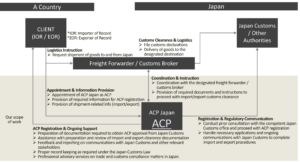
Japanese Customs System Reform: Clarification of Importer Definitions
Starting October 1, 2023, Japanese Customs has instituted a pivotal reform aimed at addressing the issue of foreign sellers improperly designating third parties (such as forwarders or customs agents) as importers.
This revision necessitates foreign corporations to utilize an Attorney for Customs Procedures (ACP) to assume the role of Importer of Record (IOR) directly in many cases. The practice of merely nominally appointing another entity as the importer is no longer feasible.
Notably, foreign corporations that act as importers themselves, through the engagement of ACP, are eligible for Japan Consumption Tax (JCT) benefits. (link: Consumption Tax Treatment and Benefits of Using ACP).
As a dedicated ACP firm, we ensure compliance with the law to facilitate correct import procedures, allowing you to trust us with your importation requirements confidently. We are eager to engage in further discussions with you.
Revisions Effective October 1, 2023:
Definition of the Importer
- Regarding a cargo imported under import transaction, an importer is equivalent to “a person who imports a cargo” defined in Article 6-1 (1), General Notification of the Customs Act. ….. This means, the Consignee, etc., in the case of imports conducted through normal transactions between an overseas seller and a Japanese buyer
- In the cases other than above, an importer is a person who has a right to disposition of the import cargo at the time of import declaration. If there is another person who acts on the purpose of the import*, that person is also included :
In case of a cargo imported:
– under lease contracts, a person who rents and uses the cargo.
– for consignment sales, a person who sells the cargo in the name of himself/herself (consignee) by accepting the commission.
– for processing or repairing, a person who processes or repairs the cargo.
– for disposal, a person who disposes the cargo.
For additional information, please refer to the following resources:
Track Record – Attorney for Customs Procedures (ACP) Services
We have supported import and export operations in Japan for over 200 clients across more than 40 countries.
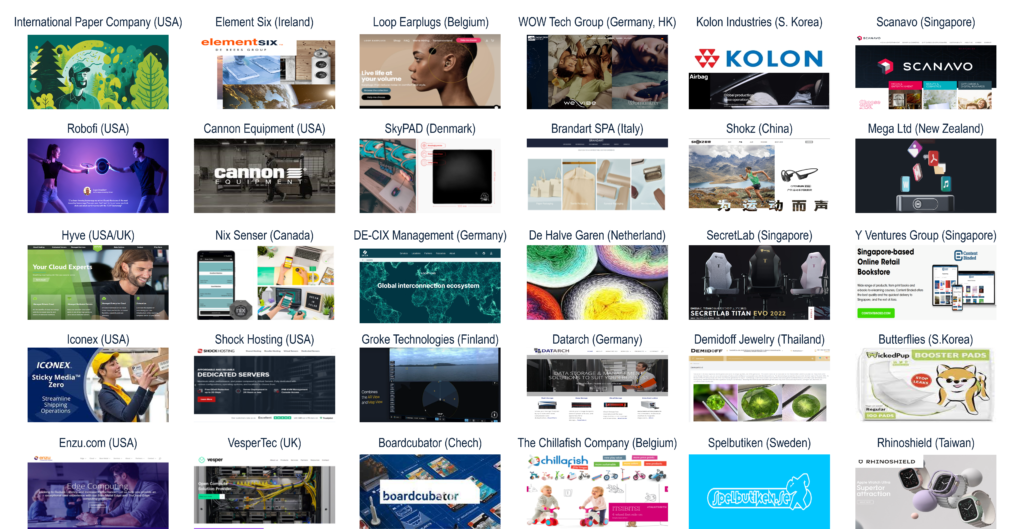
Examples of International Logistics Partners We Have Worked With
We have a proven track record of working with a wide range of logistics providers. As the Attorney for Customs Procedures (ACP), we handle customs-related responsibilities while logistics companies manage transportation and warehousing operations.
- American Overseas Transport (AOT)
- Apex International
- Brink’s
- CEVA Logistics
- Coshipper
- Crane Worldwide Logistics
- DB Schenker
- DGX (Dependable Global Express)
- DHL Express
- DHL Global Forwarding
- Dimerco
- DSV Air & Sea
- Expeditors
- FedEx Express
- FERCAM
- GOTO KAISOTEN Ltd.
- Harumigumi
- Herport
- ICL Logistics
- JAS Forwarding
- Kintetsu Express
- Kokusai Express
- Kuehne + Nagel
- Mitsubishi Logistics
- MOL Logistics
- Nankai Express
- Nippon Express
- OIA Global
- PGS
- Rhenus Group
- Röhlig
- Sankyu
- Sanyo Logistics
- Scan Global Logistics
- Seino Schenker
- SEKO Logistics
- Shibusawa Logistics Corporation
- Shin-Ei gumi
- Shiproad
- Sumitomo Warehouse
- UPS
- UPS Supply Chain Solutions
- Yamato Transport
…and many other logistics providers in Japan and around the world.