
Last Updated on May 2, 2024 by ACP JAPAN
For Foreign Corporations Without a Base in Japan:
We are informing you about the two new systems that commences in October 2023. These systems are distinct and must be approached separately. However, there are aspects where they intersect and must be understood collectively. Here’s a detailed breakdown:
Japan Customs has clarified the definitions of Importers, necessitating the shift from using IOR Providers to ACP (Attorney for Customs Procedures) in numerous instances
Since October 2023, Japan Customs mandated that foreign corporations (non-residents) without a presence in Japan must act as importers themselves in many situations. Utilizing another company to serve nominally as the importer, such as an IOR service provider, will no longer be an option.
To comply with these regulations, foreign corporations lacking a Japanese base need to appoint an ACP (Attorney for Customs Procedures), making the ACP system essential for their operations.


Why this System Change?
There have been instances where foreign corporations, along with importing agents unfamiliar with customs laws or lacking proper compliance awareness, have collaborated. Such collaborations often result in the failure to accurately pay the necessary duties and consumption taxes upon importation by utilizing undervalued invoices, almost simulating a sales transaction. To address this issue, Japan Customs now instructs foreign corporations to engage with ACP. Using ACP mandates that commercial distribution transaction details be presented to the customs office, ensuring the declaration of an appropriate import value.
Typically, the import declaration value is derived by subtracting certain domestic costs from the projected domestic sales price, in line with the Japanese Customs Tariff Law. However, we believe there’s no significant cause for concern regarding this value. Japan’s tariff rate is relatively low on an international scale, and the import consumption tax is primarily a “tax borne by the end consumer”. Though a 10% consumption tax is required at the point of import, it can be recouped from customers during sales. If a tax return is accurately filed, any overpayments will be refunded.
Moreover, to claim credits for the consumption tax on purchases (paid upon importation), the seller—a foreign corporation—must assume the role of an importer. Alongside appointing an ACP, foreign entities should also designate a tax accountant to act as a tax agent. This ensures the accurate filing of consumption tax returns with the tax office.
As seasoned ACP professionals, we lead consultations with Japan Customs proactively to guarantee seamless import customs clearance and oversee the determination of import declaration values, among other critical aspects. Our expertise extends to countless import/export projects, and we pride ourselves on a flawless record of customs clearance.
Related Readings:
- ACP Japan’s – IOR/ACP Service, Attorney for Customs Procedure
- Announcement from Japan Customs | Directive to use ACP – Attorney for Customs Procedure
Qualified Invoice System (QIS) for Japan Consumption Tax (JCT)
The forthcoming alteration pertains to the national tax system.
The advent of the consumption tax invoice system means a surge in overseas companies becoming consumption tax invoice issuers. For Japanese customer (buyer) during a consumption tax return filing must emanate from a registered invoice issuing entity, otherwise the Japanese customer can not claim the purchase tax credit on the consumption tax paid to a seller.
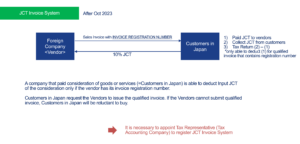
Should an overseas company opt to become an invoice issuing entity, it is automatically becoming as a taxable entity for consumption tax. This necessitates the submission of a periodical consumption tax return with the tax authorities. Therefore, companies are urged to carefully consider whether they cater to B2C consumers (typically not filing consumption tax returns) or B2B entities (usually filing such returns), before deciding on registration.
For the case of a non-resident entity (Company-A), when Company-A imports and sells to customers in Japan, following 3 steps are the standard procedure.
(1) Pay import JCT to a customs office, 10% of the import customs value when Company-A imports.
<PAY TO CUSTOMS OFFICE>
(2) Obtain JCT from a customer in Japan, 10% of the sales price when Company-A sells
(3) Submit JCT tax return
(3-1) If you paid (1) as IOR = Importer, which means you appoint ACP, then you’re required to pay only the difference amount (2) – (1)
(3-2) If you paid (1) but you were not IOR = Importer, then you’re required to pay all the amount of (2). You can’t deduct (1).
Please be careful that only the IMPORTER can deduct the input JCT (import consumption tax) at the time of tax filing mentioned above (3). In other words, if another IOR service provider became the IMPORTER when you import, basically it would not be possible for the non-resident entity to deduct the input JCT (import consumption tax). Therefore, you have to pay all the amount of (2) to a tax office (mentioned above (3-2).
On the other hand, by importing with ACP and becoming the IMPORTER, you can deduct the input JCT (import consumption tax) when filing JCT tax returns as mentioned above (3). Therefore, you would only need to pay the difference amount (2) – (1) to a tax office (as mentioned above (3-1).
This is one of the significant advantages of using the ACP service instead of the IOR service.
For this reason, we strongly recommend using ACP so that you can become IOR.

Related Readings:
- Consumption Tax – Import into Japan by ACP
- New Japan Qualified Invoice System and import JCT (Japan Consumption Tax)
Our ACP Service: The Best Solution for the Japan Importer of Record (IOR) and Exporter of Record (EOR)
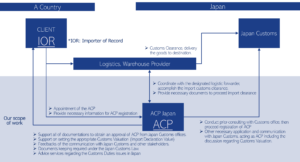
Attorney for Customs Procedures (ACP) is the best solution for addressing the issue of Japan IOR – Importer of Record. Below is an outline of our primary services and a diagram illustrating the operational structure of the ACP service. Upon successful ACP registration, a foreign entity can become the Japan IOR – Importer of Record.
Basic Scope of Services:
- Consultation with the Japan Customs Office for successful ACP registration.
- Liaising with stakeholders, including Logistics Forwarding Companies and the Customs Offices, on behalf of non-resident clients (i.e., non-resident Japan IOR) to ensure the secure importation of goods.
- Assistance in preparing the necessary documentation for import clearance.
- Support of calculation of Customs Value (Customs Valuation Formula), in accordance with appropriate compliance under the Japan Tariff Customs Law.
- Security Export Control (Classification for List Control, Examination for Catch-All Control, Application of the license to Ministry of Economy, Trade and Industry)
- Documents keeping, required under article 95 – Japan Customs Law
- Providing professional trade/customs advice if any issues arise.
**Both import and export activities can benefit from the use of an ACP (Attorney for Customs Procedures). This support is applicable in scenarios where a non-resident acts as the Importer of Record (IOR) for imports and as the Exporter of Record (EOR) for exports.
Three Steps to Initiate Shipments Under the ACP Program: :
- Quotation Review to Contract Conclusion: Upon receiving your contact details, we will promptly provide a quotation for your review.
- Commencing the Registration of ACP (Attorney for Customs Procedure) to Japan Customs: This process is generally completed in about two weeks.
- Initiation of First Shipment, Import/Export
Our Customers – Japan IOR / Attorney for Customs Procedures (ACP) Service
All our clients have successfully become Japan Importer of Record (IOR) and imported goods into Japan under our guidance.

Logistics Companies with Collaboration Experience
Here is a list of our partner logistics and forwarding companies with whom we have had successful collaborations. Please note that this list is not exhaustive, as we are open to working with any logistics or forwarding companies. As Attorneys for Customs Procedures (ACP), we represent non-resident clients (IOR) and coordinate with these logistics companies, who manage the transportation of goods to and from Japan.

Please Be Careful
In cases where foreign corporations (non-residents) without an office in Japan import goods, failure to properly prepare an Importer of Record (IOR) through an Attorney for Customs Procedures (ACP) or similar means can result in goods being held at customs, leading to significant delays and costs. To avoid such risks, please make thorough preparations.
If an ACP is needed, it is crucial to utilize the services of an experienced ACP well-versed in customs-related laws and regulations. The import and export operations of non-residents/foreign corporations using an ACP are treated as unique cases. Many customs brokers are not familiar with these procedures, leading to incidents where goods are detained for extended periods due to unsuccessful explanations to customs. (Customs will not permit the import if the explanations provided by the importer or customs broker are unsatisfactory, resulting in the goods being detained until customs is convinced.)
We highly recommend utilizing our services as professional experts in customs, knowledgeable about customs-related laws and regulations. With a proven track record of resolving numerous issues through direct consultations with customs officers and customs brokers, our clients supported as an ACP now exceed 100 companies. We are committed to delivering industry-leading results with our expertise.
Why choose us?
- Customs and International Trade Professionals – Our CEO, Mr. Sawada, is a Certified Customs Specialist in Japan. With years of experience providing services in the Trade & Customs field, his leadership at KPMG and the establishment of his own company, SK Advisory, ensures our commitment to excellence and high-quality service.
- Full Adherence to Japanese Customs Law – Our top priority is to maintain full compliance with Japanese Customs Law and safely import / export our clients’ goods into / from Japan. We meticulously manage all import compliance aspects, including Japan Importer of Record (IOR) matter, HS code classification and the correct Customs Valuation of goods entering Japan. We support to complete all the necessary shipping documents, such as Invoice, Packing List and BL, on behald of non-resident / foreign Japan IOR.
- Communication in English, Chinese, and Japanese – Our team, with extensive international experience, excels in communication in English, including facilitating English-language meetings, and has earned considerable trust from clients. We also have staff capable of communicating in Chinese, making us equipped to handle Chinese-language support as well. Naturally, as a Japan-based team, we’re totally fluent in Japanese, ensuring seamless communication across these three key languages.
- Reputable and Reliable Partner -The growing demand for our Attorney for Customs Procedures (ACP) services is testament to our quality. We proudly serve clients globally, registering over 50 ACP customers annually. Our consistent track record underscores our reliability and credibility. Our unwavering commitment ensures all our clients successfully acquire Japan IOR status and import goods seamlessly into Japan.
- Handling Regulated Products – Our ACP/IOR partnership system can manage regulated items, including cosmetics, PSE-products, foodstuffs, and tableware.
- Recognized ACP Service Provider on Amazon SPN (Service Provider Network) – We are a certified ACP service provider within Amazon’s Service Provider Network (SPN), listed under the Trade Compliance category. Many international Amazon Sellers have successfully become Japan Importers of Record (IOR) through our ACP services.

FAQ for ACP (Attorney for Customs Procedures)
What is the role of ACP (ACP Japan)?
- Representation: ACP (ACP Japan) represents the foreign importer and liaises with Japan Customs and the Forwarding Company/Customs Broker.
- Documentation and Compliance: ACP assists in preparing essential import documents (e.g., Invoices) in compliance with Japan Customs Law and formally requests the Customs Broker to proceed with customs clearance.
- Expert Consultation and Troubleshooting: We are a team of legal experts in Customs Laws, providing direct consultations with Japan Customs to ensure compliance and address issues, including troubleshooting unique challenges in non-resident imports.
How long time does it require to get ACP’s registration?
It will take approximately 2 weeks until getting an approval from Japan Customs Office.
The breakdown of the task is as follows.
- Prepare the necessary documentation between us
- Start pre-consultation with Japan Customs Office and proceed initial review
- Submit paper-based set of application documents to Japan Customs Office for final review
What kind of documents to be necessary for ACP application?
Not limited, but for instance – Power of Attorney, Company Registry, The calculation method of Customs Valuation, Catalog of the import goods, business/logistic flow
ACP can handle all kinds of goods?
Whereas many ACP service providers do not handle regulated items, our company’s competitive advantage stems from our ability to manage such products. We can support regulated items, including cosmetics, PSE-regulated products, foodstuffs, and tableware.
Which regions in Japan are we covering?
Any region in Japan, we can handle.
What is difference between ACP and IOR?
ACP is not the Importer. ACP enables non-resident entities to become IOR (Importer of Record).
—–
[Our Service]
Our ACP Service for Importer of Record (IOR)
Our ACP Service for Exporter of Record (EOR)
[Knowledge Pages]
What is ACP? – Attorney for Customs Procedures
Steps of using ACP, how foreign entity can import into Japan by ACP
What is IOR? – Importer of Record
Customs Valuation System in Japan
Customs Valuation When You Import By ACP
Limitation on Handling by ACP in Japan – Our System Enables Us to Handle Regulated Items
[Recent Updates]
ACP Japan Became Amazon’s SPN Provider as Qualified ACP Service Provider
Taxes on Imports: Customs Duty and Japan Consumption Tax (JCT)
Import Permit Document and Alert on IOR Service
New Japan Qualified Invoice System and import JCT (Japan Consumption Tax)