Category Archives: Tax

Japan’s New E-Commerce Platform Taxation Regime (FY2026 Japanese Tax Reform Outline)

Japan Consumption Tax Reform on Cross-Border E-Commerce

In December 2025, the Japanese ruling parties released the FY2026 Tax Reform Outline.
The outline includes significant reforms to Japan Consumption Tax (JCT) aimed at ensuring proper taxation of cross-border e-commerce (CBEC) involving the sale of goods.

Key Changes

1. Shift of JCT Filing and Payment Obligation to Large Platform Operators from Individual Sellers

For sales of goods conducted through online platforms, platform operators with total intermediary sales exceeding JPY 5 billion will become liable for filing and paying JCT on behalf of the sellers.

2. Review of the Small-Value Import Tax Exemption

For cross-border mail-order sales, goods priced at JPY 10,000 or less (excluding tax) will also become subject to JCT, although previously they were JCT exempted. Under the new rules, the seller will bear the JCT filing obligation.

Effective date: On or after April 1, 2028


1. Introduction of Platform Taxation for the Sale of Goods

The Japanese government has long regarded it as a major issue that consumption tax collected by foreign sellers (non-residents) through large e-commerce platforms such as Amazon is often not properly reported or paid.

According to the Government, it has been suggested that uncollected JCT related to fulfillment-based sales by foreign sellers in Japan may amount to approximately JPY 500 billion to JPY 1 trillion annually. (source: Government Tax Commission – Expert Panel, June 11, 2025)

To address this issue, Japan plans to shift the JCT payment obligation from individual foreign sellers to large-scale platform operators, requiring platforms to collect and remit JCT in aggregate.

Possible import JCT refund scenarios under the new platform taxation regime

Under the current system, when a foreign seller files JCT returns in Japan, import JCT paid at the time of importation can only be claimed as an input tax credit if the foreign seller itself acts as the Importer of Record (IOR).
This requires appointing an Attorney for Customs Procedures (ACP) and retaining the import permit issued by Japan Customs.

Under the new platform taxation framework, platform operators such as Amazon are expected to remit JCT on behalf of foreign sellers.
At the same time, import JCT paid by foreign sellers is expected to be creditable at the platform level, based on the tax reform outline.

While detailed regulations are yet to be finalized, the outline suggests the following structure:

Foreign sellers will continue to pay import JCT to Japan Customs at the time of importation.

Platform operators applying input tax credits will likely refund the corresponding import JCT amount to the foreign sellers.

However, input tax credits at the platform level will only be allowed for goods imported under the name of the foreign seller as the IOR.
Accordingly, platforms are expected to require import permits clearly showing the foreign seller as the importer.

As a result, if goods are imported under the name of a third party (e.g., a warehouse, or any IOR service provider), the platform may not be able to apply the input tax credit, and the foreign seller may not receive reimbursement of the import JCT.

Practical Implications for Foreign Sellers

For foreign sellers, it is therefore critically important to establish an import structure in which they act as the Importer of Record (IOR) by appointing an Attorney for Customs Procedures (ACP).

In preparation for the new system, we strongly recommend reviewing and restructuring import operations at an early stage to ensure compliance.

Notably, following the October 2023 revision of the Japan Customs Act, foreign sellers selling through e-commerce platforms such as Amazon have already been required to act as importers themselves through the use of an ACP.
From this perspective, the 2023 customs reform and the upcoming consumption tax reform are aligned in policy intent.

As specialists in ACP services, we have supported more than 200 foreign companies in establishing compliant import structures in Japan.
We are happy to assist you in building an import framework that enables proper treatment of import JCT and future tax adjustments with e-commerce platforms.


2. Review of the Small-Value Import Tax Exemption

Previously, when Japanese consumers ordered goods that were shipped directly from overseas sellers without using fulfillment services, imports with a taxable value of JPY 10,000 or less were exempt from consumption tax.

However, this exemption has been criticized for creating competitive distortions compared to domestic businesses that bear consumption tax on their procurement costs.

To address this issue, Japan plans to abolish the exemption for small-value goods, making sales of goods priced at JPY 10,000 or less (so-called “specified low-value assets”) subject to JCT, with the seller responsible for tax payment.


3. Outlook and Next Steps

At this stage, the reforms are based on the FY2026 Tax Reform Outline, and detailed legislation and operational rules will be finalized following Diet deliberations.

We will continue to monitor legislative developments closely and provide timely updates as further details become available.

If you have any questions regarding ACP services, Importer of Record structures, or the impact of the new platform taxation rules, please feel free to contact us.

Only Importer of Record is Eligible for Deduction of Import JCT – Japan Consumption Tax

In Japan, only the Importer of Record (IOR) is eligible to deduct input (import) consumption tax in principle

The taxpayer liable for the Japan Consumption Tax on Imported Goods from the bonded area, and is considered the importer under Japanese customs law. Under customs law, the importer is defined as the taxpayer, known as the “Importer of Record – IOR” (Customs Law Articles 6 and 7(1), Basic Customs Notification 7-1).

Since the Importer of Record (IOR) is liable for the tax on taxable goods, such an entity, as a business, is eligible to deduct the related Japan Consumption Tax under the Consumption Tax Law (Consumption Tax Law Article 30, Paragraphs 1(3) and (4)).

As of October 1, 2023, amendments to the Customs Regulations have tightened the definition of who can be an “Importer of Record (IOR)”. Only those involved in the transaction, such as buyers who import through sales transactions or those with ownership and disposal rights over the goods, are allowed. Third parties uninvolved in the transaction cannot be Importers of Record (IOR). Foreign corporations without a physical presence in Japan (non-residents) can use our Attorney for Customs Procedures (ACP) service, allowing non-residents themselves to become Importer of Record (IOR) and deduct (or refund) import Consumption Tax.

We have extensive experience in facilitating such tax deductions (or refunds).

Case of Different Substantial Importer and Importer of Record

According to the Tokyo District Court decision on February 20, 2008, “In principle, a tax system where taxable entrepreneurs themselves deduct the taxes paid at the import stage should be assumed. Unless there are special circumstances, it should be understood that a plaintiff who is not the importer of record will not have their consumption tax deductible.” It indicates that tax declarations made in the name of a third party are not intended by law.  We can learn from this court case that only the Importer of Record (IOR) has the right to deduct input tax amounts.  

In very limited cases, substantial importers who are not the formal Importer of Record are allowed to deduct input tax amounts.

Practically, it is appropriate to assume that entities who are not the Importer of Record (IOR) are not allowed to deduct import consumption tax.

An exception that allows the deduction of input tax amounts for those not being the importer of record exists under Basic Consumption Tax Notification 11-1-6 “Handling in Cases Where the Substantial Importer and the Importer of Record Differ”. This directive states that even if the importer of record differs from the substantial importer, the following conditions, if met, allow the substantial importer to deduct the consumption tax paid on their taxable goods:

  1. The substantial importer sells the taxable goods to the importer of record (manufacturer, etc.) for a consideration after importing.
  2. The substantial importer bears the consumption tax amount related to the retrieval of the taxable goods.
  3. The substantial importer preserves the original import permit and receipt of the consumption tax related to the retrieval issued in the name of the importer.

*Please bear in mind that the applicability of this exceptional rule is extremely limited. Therefore, as a general rule, only the Importer of Record (IOR) is eligible to claim input Japan Consumption Tax (JCT).


Japanese Customs System Reform: Clarification of Importer Definitions

Starting October 1, 2023, Japanese Customs has instituted a pivotal reform aimed at addressing the issue of foreign sellers improperly designating third parties (such as forwarders or customs agents) as importers.

This revision necessitates foreign corporations to utilize an Attorney for Customs Procedures (ACP) to assume the role of Importer of Record (IOR) directly in many cases. The practice of merely nominally appointing another entity as the importer is no longer feasible.

Notably, foreign corporations that act as importers themselves, through the engagement of ACP, are eligible for Japan Consumption Tax (JCT) benefits. 

As a dedicated ACP firm, we ensure compliance with the law to facilitate correct import procedures, allowing you to trust us with your importation requirements confidently. We are eager to engage in further discussions with you.

Revisions Effective October 1, 2023:

Definition of the Importer

  • Regarding a cargo imported under import transaction, an importer is equivalent to “a person who imports a cargo” defined in Article 6-1 (1), General Notification of the Customs Act. ….. This means, the Consignee, etc., in the case of imports conducted through normal transactions between an overseas seller and a Japanese buyer
  • In the cases other than above, an importer is a Person Having the Right of Disposal of the import cargo at the time of import declaration. If there is another person who acts on the purpose of the import*, that person is also included :

 In case of a cargo imported:
     – under lease contracts, a person who rents and uses the cargo.
     – for consignment sales, a person who sells the cargo in the name of himself/herself (consignee) by accepting the commission.
     – for processing or repairing, a person who processes or repairs the cargo.
     – for disposal, a person who disposes the cargo.

Importer Defined as the “Person Having the Right of Disposal”

One of the most notable aspects of the amendment is the clarification that the “person having the right of disposal” is regarded as the importer under Japan Customs law. The term “right of disposal” is similar to ownership, but not identical. Although there is no explicit definition in the customs-related legislation, according to Japan Customs, it refers to the authority to decide how the goods will be handled after being released into Japan—for example, whether to sell the goods or to enter into a sales contract.

For additional information, please refer to the following resources:


Our Japan Consumption Tax (JCT) Representative Services

At ACP Japan, we provide a comprehensive one-stop service that covers both customs procedures through the Attorney for Customs Procedures (ACP) and Japan Consumption Tax (JCT) procedures with the National Tax Agency through a designated JCT Tax Representative.

By working closely with our trusted partner tax accountants, we act as your ACP while maintaining close coordination and information sharing with the tax representative.

This collaboration ensures the proper deduction and refund of Japan Consumption Tax paid at the time of importation.  


Our ACP Service: The Best Solution for the Japan Importer of Record (IOR) and Exporter of Record (EOR)

ACP is an effective solution for addressing Importer of Record (IOR) and Exporter of Record (EOR) requirements in Japan. Through our ACP service, non-resident entities located outside Japan are able to import and export goods as Non-Resident IOR and EOR.

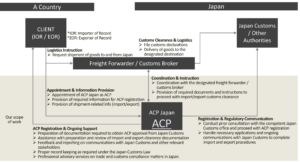
Below is an overview of our basic scope of work, together with a diagram illustrating the operational structure of the ACP service. Once ACP registration is completed, the non-resident entity can act as the Importer of Record (IOR) and Exporter of Record (EOR) in Japan.

Scope of Work – How We Can Assist

  • Consultation with Japan Customs to support successful ACP registration.
  • Liaison with relevant stakeholders, including freight forwarders and Japan Customs, to ensure the smooth and compliant import and export of goods.
  • Assistance in preparing and reviewing import and export clearance documentation.
  • Support in the calculation of customs value, in accordance with the Japan Customs Tariff Act.
  • Assistance with advance rulings on HS classification, customs valuation, and rules of origin.
  • Import compliance support for regulated products, including Domestic Administrator (sometimes referred to as “Domestic Representative”) Services under the Product Safety Acts (PSE/PSC) and food-related products regulated under the Food Sanitation Act.
  • Support for security export control, including list-based classification, catch-all control assessment, and assistance with export license applications to the Ministry of Economy, Trade and Industry (METI).
  • Record-keeping support in accordance with Article 95 of the Japan Customs Law.
  • Provision of professional trade and customs advisory services to address and resolve issues that may arise during import or export operations.

**Both import and export activities can benefit from the use of an ACP (Attorney for Customs Procedures). This support is applicable in scenarios where a non-resident acts as the Importer of Record (IOR) for imports and as the Exporter of Record (EOR) for exports.

Three Steps to Initiate Shipments Under the ACP Program:

  1. Quotation Review to Contract Conclusion: Upon receiving your contact details, we will promptly provide a quotation for your review.
  2. Commencing the Registration of ACP (Attorney for Customs Procedures) to Japan Customs: This process is generally completed in about two weeks.
  3. Initiation of First Shipment, Import/Export


Track Record – Attorney for Customs Procedures (ACP) Services

We have supported import and export operations in Japan for over 200 clients across more than 40 countries.  

Examples of International Logistics Partners We Have Worked With

We have a proven track record of working with a wide range of logistics providers. As the Attorney for Customs Procedures (ACP), we handle customs-related responsibilities while logistics companies manage transportation and warehousing operations.

  • Apex International
  • Brink’s
  • CEVA Logistics
  • Coshipper
  • Crane Worldwide Logistics
  • DB Schenker
  • DGX (Dependable Global Express)
  • DHL Express
  • DHL Global Forwarding
  • Dimerco
  • DSV Air & Sea
  • Expeditors
  • FedEx Express
  • FERCAM
  • GOTO KAISOTEN Ltd.
  • Harumigumi
  • Herport
  • ICL Logistics
  • JAS Forwarding
  • Kintetsu Express
  • Kokusai Express
  • Kuehne + Nagel
  • Mitsubishi Logistics
  • MOL Logistics
  • Nankai Express
  • Nippon Express
  • OIA Global
  • PGS
  • Rhenus Group
  • Röhlig
  • Sankyu
  • Sanyo Logistics
  • Scan Global Logistics
  • Seino Schenker
  • SEKO Logistics
  • Shin-Ei gumi
  • Shiproad
  • Sumitomo Warehouse
  • UPS
  • UPS Supply Chain Solutions
  • Yamato Transport

…and many other logistics providers in Japan and around the world.  

Japan JCT Tax Obligations for Foreign Corporations with a Capital of Over 10 Million Yen (Amendments to the Consumption Tax Law, April 2024)

Consumption tax in Japan applies to the transfer of assets conducted domestically by businesses, which means that non-residents and foreign corporations are also subject to consumption tax and are obliged to pay it if they transfer assets within Japan.

In some cases, such as exempt businesses, it may not be necessary to pay the tax to the national tax office.

However, the following are examples where one cannot qualify as an exempt business and must file for consumption tax:

Examples where JCT tax filing is required:

  1. Qualified JCT Invoice Issuers
  2. Businesses with taxable sales exceeding JPY 10 million in the base period (roughly speaking, the fiscal year two years prior) for the taxable period
  3. Businesses with taxable sales exceeding JPY 10 million for the specified period (roughly speaking, the first six months of the previous fiscal year, etc.)
  4. New corporations (including specified newly established corporations) with capital or investment of JPY 10 million or more for taxable periods without a base period
  5. Businesses that have made the election to become a taxable enterprise

※ With the amendments to the Consumption Tax Law in April 2024, regarding point 4, if a foreign corporation has capital or contributions exceeding 10 million yen when they start business operations in Japan (including specified newly established corporations), regardless of when the corporation was established abroad, they are obliged to pay taxes and declare from the fiscal year they start operations in Japan (applicable for taxable periods starting after October 1, 2024).

We specialize in navigating complex issues at the intersection of customs procedures and taxation—an area where our ability to offer practical, comprehensive support from both perspectives sets us apart. Understanding the close relationship between customs duties and national taxes (especially, Japan Consumption Tax – JCT), and addressing both in an integrated manner, is crucial in the context of international trade.


      

What Is a JCT Tax Representative and Why Is It Required?

When a non-resident foreign entity becomes subject to Japan’s Consumption Tax (JCT), it is required to appoint a JCT Tax Representative (Tax Agent).

If a non-resident company sells goods to customers in Japan, it typically collects 10% consumption tax on those sales. This collected JCT must be reported and submitted to the Japanese National Tax Office, unless the entity qualifies as a tax-exempt business. (See: “Are we a Tax-Exempt Business?”)

If the entity is JCT-liable—or voluntarily registers as a taxable entity, such as by obtaining a Qualified Invoice Issuer Number—it must appoint a JCT Tax Representative to handle all tax-related procedures in Japan, including JCT tax filings.

In the JCT tax return process, the paid import JCT can be offset against the collected JCT.

  • If the import JCT exceeds the collected amount, the difference may be refunded.
  • If the collected JCT exceeds the import amount, the difference must be paid to the tax office.

A JCT Tax Representative is legally required to manage this process on behalf of the foreign entity.

Please note:

The JCT Tax Representative is distinct from the Attorney for Customs Procedures (ACP), which is appointed for customs clearance purposes.

  • ACP = Customs representative
  • JCT Tax Representative = Tax representative

Our Japan Consumption Tax (JCT) Representative Services

At ACP Japan, we provide a comprehensive one-stop service that covers both customs procedures through the Attorney for Customs Procedures (ACP) and Japan Consumption Tax (JCT) procedures with the National Tax Agency through a designated JCT Tax Representative.

By working closely with our trusted partner tax accountants, we act as your ACP while maintaining close coordination.


JCT Compliance

Understanding the handling of JCT (such as payment of import JCT, collection of sales JCT from customers, and JCT returns) is crucial to avoid significant cost burdens. This is a vital aspect, so please ensure a thorough understanding to determine the most optimal business model.

Basic procedure

For non-resident entities (Company-A) that import and sell goods to customers in Japan, the standard procedure involves three steps:

  1. Pay import Japan Consumption Tax (JCT) to a customs office, 10% of the import customs value when Company-A imports goods.  <PAY TO CUSTOMS OFFICE>
  2. Obtain JCT from customers in Japan, 10% of the sales price when Company-A sells goods.
  3. Submit JCT tax return and pay the difference amount (2) – (1) to a tax office periodically  <PAY TO TAX OFFICE (different authority from Customs Office)>

Note: Using ACP to become the importer (IOR) is essential for JCT deductions and refunds. If another company acts as the IOR, you cannot deduct the input tax (step 1), and must pay the entire VAT collected (step 2) to the national tax authorities, leading to significant costs.

If you are a JCT-exempt business, the process ends at steps 1 and 2. For taxable businesses or invoice-registered businesses, step 3 (Final Tax Return) is obligatory.

In the Final Tax Return (step 3), if the JCT paid (step 1) exceeds the provisional JCT received (step 2), the difference is refunded. Conversely, if the provisional JCT received (step 2) exceeds the JCT paid (step 1), the difference must be paid to the tax office.

Why IMPORTER is important?

It is crucial to note that only the IMPORTER can deduct the import consumption tax at the time of tax filing. (= Deduct above (1) from (2) )

If Company-A uses another company to act IMPORTER, then Company-A can’t do above (3). Company-A has to pay all the amount of (2) to a tax office.

However, if Company-A imports goods using the Attorney for Customs Procedure (ACP), it becomes the Importer and can deduct the import consumption tax when filing the JCT tax return. In this case, Company-A only needs to pay the difference between the JCT collected from customers and the import JCT (2) – (1) paid to the Tax Office.


Appoint a tax accounting firm as Tax Representative / Tax Agent

Apart from utilizing ACP, when filing taxes in Japan (3), Company-A must appoint a Tax Representative. The Tax Representative will handle JCT tax registration and JCT filings with the tax office on behalf of the non-resident entity. ACP Japan can introduce our partner tax accounting company that can act as the Tax Representative.


Are we a Tax-Exempt Business?

Tax Filing Obligations of Nonresidents and Foreign Corporations

First, the consumption tax received from customers in Step 2 above should basically be paid to the national tax office. Consumption tax is imposed on transfers, etc. of assets made in Japan. Therefore, even if a nonresident or foreign corporation transfers assets in Japan, it is subject to consumption tax and is obligated to pay the tax.

In some cases, such as exempt businesses, it may not be necessary to pay the tax to the national tax office.

However, the following are examples where one cannot qualify as an exempt business and must file for consumption tax:

Examples of Entities Required to File JCT Tax Returns (Non-Exempt Businesses)

  • Qualified Invoice Issuers:
    Businesses registered as qualified invoice issuers under Japan’s invoice system.
  • Businesses with Taxable Sales Exceeding JPY 10 Million During the Base Period:
    Entities whose taxable sales in Japan during the base period (generally the fiscal year two years prior) exceed JPY 10 million.
  • Businesses with Taxable Sales Exceeding JPY 10 Million During the Specific Period:
    Entities whose taxable sales in Japan during the specific period (generally the first six months of the previous fiscal year) exceed JPY 10 million.
  • Newly Established Corporations with Capital of JPY 10 Million or More:
    Newly established corporations (including certain newly established corporations) with capital or investment of JPY 10 million or more during a taxable period without a base period.
  • Foreign Corporations with Capital of JPY 10 Million or More Deemed to Have No Base Period: (Applicable to taxable periods starting on or after October 1, 2024) *
    Foreign corporations without a base period and with capital or investment of JPY 10 million or more at the start of the fiscal year are not exempt from consumption tax obligations.
  • Businesses Opting for Taxable Enterprise Status:
    Entities that voluntarily select to be treated as taxable enterprises.

Disclaimer: The above outlines the general principles of Japan’s consumption tax obligations. Each company’s specific tax liability should be confirmed by consulting with a licensed tax accountant.

If you’re an Exempted entity

During the exempt term, a new entity is not required to file tax returns. As long as your entity has exempt status, you are only required to:
(1) Pay 10% tax of the import customs value when you import goods.
(2) Collect 10% of the sales price when you sell goods.
That’s all. You can enjoy the difference (2) – (1).


Can Tax-Exempt Businesses Receive Refunds?

Yes, however, a final JCT tax return (Step 3) is required in order to receive a refund. Even if your business is initially classified as tax-exempt, you may voluntarily register as a taxable entity and begin filing JCT tax returns to claim refunds for import JCT you have paid. 

This can be beneficial, for example, when the JCT paid at import (Step 1) exceeds the JCT collected from customers (Step 2). In such cases, the difference may be refunded by the National Tax Office.

Importantly, to claim a refund or deduction for import JCT, the use of an Attorney for Customs Procedures (ACP) is essential for non-resident businesses—only ACP-registered importers are eligible for JCT recovery.


Our ACP Service: The Best Solution for the Japan Importer of Record (IOR) and Exporter of Record (EOR)

ACP is an effective solution for addressing Importer of Record (IOR) and Exporter of Record (EOR) requirements in Japan. Through our ACP service, non-resident entities located outside Japan are able to import and export goods as Non-Resident IOR and EOR.

Below is an overview of our basic scope of work, together with a diagram illustrating the operational structure of the ACP service. Once ACP registration is completed, the non-resident entity can act as the Importer of Record (IOR) and Exporter of Record (EOR) in Japan.

Scope of Work – How We Can Assist

  • Consultation with Japan Customs to support successful ACP registration.
  • Liaison with relevant stakeholders, including freight forwarders and Japan Customs, to ensure the smooth and compliant import and export of goods.
  • Assistance in preparing and reviewing import and export clearance documentation.
  • Support in the calculation of customs value, in accordance with the Japan Customs Tariff Act.
  • Assistance with advance rulings on HS classification, customs valuation, and rules of origin.
  • Import compliance support for regulated products, including Domestic Administrator (sometimes referred to as “Domestic Representative”) Services under the Product Safety Acts (PSE/PSC) and food-related products regulated under the Food Sanitation Act.
  • Support for security export control, including list-based classification, catch-all control assessment, and assistance with export license applications to the Ministry of Economy, Trade and Industry (METI).
  • Record-keeping support in accordance with Article 95 of the Japan Customs Law.
  • Provision of professional trade and customs advisory services to address and resolve issues that may arise during import or export operations.

**Both import and export activities can benefit from the use of an ACP (Attorney for Customs Procedures). This support is applicable in scenarios where a non-resident acts as the Importer of Record (IOR) for imports and as the Exporter of Record (EOR) for exports.

Three Steps to Initiate Shipments Under the ACP Program:

  1. Quotation Review to Contract Conclusion: Upon receiving your contact details, we will promptly provide a quotation for your review.
  2. Commencing the Registration of ACP (Attorney for Customs Procedures) to Japan Customs: This process is generally completed in about two weeks.
  3. Initiation of First Shipment, Import/Export
 

Track Record – Attorney for Customs Procedures (ACP) Services

We have supported import and export operations in Japan for over 200 clients across more than 40 countries.  

Examples of International Logistics Partners We Have Worked With

We have a proven track record of working with a wide range of logistics providers. As the Attorney for Customs Procedures (ACP), we handle customs-related responsibilities while logistics companies manage transportation and warehousing operations.

  • Apex International
  • Brink’s
  • CEVA Logistics
  • Coshipper
  • Crane Worldwide Logistics
  • DB Schenker
  • DGX (Dependable Global Express)
  • DHL Express
  • DHL Global Forwarding
  • Dimerco
  • DSV Air & Sea
  • Expeditors
  • FedEx Express
  • FERCAM
  • GOTO KAISOTEN Ltd.
  • Harumigumi
  • Herport
  • ICL Logistics
  • JAS Forwarding
  • Kintetsu Express
  • Kokusai Express
  • Kuehne + Nagel
  • Mitsubishi Logistics
  • MOL Logistics
  • Nankai Express
  • Nippon Express
  • OIA Global
  • PGS
  • Rhenus Group
  • Röhlig
  • Sankyu
  • Sanyo Logistics
  • Scan Global Logistics
  • Seino Schenker
  • SEKO Logistics
  • Shin-Ei gumi
  • Shiproad
  • Sumitomo Warehouse
  • UPS
  • UPS Supply Chain Solutions
  • Yamato Transport

…and many other logistics providers in Japan and around the world.  


Japan Consumption Tax (JCT) – Basic Flow for Overseas Companies in Japan

Understanding the handling of JCT (such as payment of import JCT, collection of sales JCT from customers, and JCT returns) is crucial to avoid significant cost burdens. This is a vital aspect, so please ensure a thorough understanding to determine the optimal business model.

Basic procedure

When a foreign entity without a physical presence in Japan (a non-resident company) imports goods into Japan and subsequently sells them within Japan, the handling of Japan Consumption Tax (JCT) can be broadly divided into the following three steps:

Step 1: At the Time of Import

  • You are required to pay import consumption tax equivalent to 10% of the customs-declared value plus customs duties to Japan Customs.
  • Foreign entities without a base in Japan must appoint an Attorney for Customs Procedures (ACP) so that the foreign entities can act as the IOR (Importer of Record) themselves.

Step 2: At the Time of Sale

  • When selling goods domestically, you must collect 10% consumption tax from the customer on the sales price.

Step 3: Tax Return Filing (Typically Annually)

You file an annual consumption tax return, paying the difference between:

  • the JCT collected from customers (output tax), and
  • the JCT paid at the time of import and other business purchases (input tax).

If input tax exceeds output tax, the excess amount may be refunded.
A Tax Representative (licensed Japanese tax accountant) must be appointed to support this process.

Please note:

Only entities listed as the Importer of Record (IOR) are eligible to claim input tax credits or obtain a refund for Japan’s import consumption tax (JCT). Therefore, foreign entities must appoint an Attorney for Customs Procedures (ACP) in order to act as the IOR themselves.
If another company is listed as the IOR, you will not be able to deduct the import JCT on your own tax return. In that case, you would be required to remit the full amount of collected JCT to the tax office—resulting in significant additional costs.

If You Qualify as a JCT-Exempt Business

If you meet the requirements to be treated as a JCT-exempt business, you may choose either of the following:

  1. Operate as a JCT-exempt business; or
  2. Register as a JCT-taxable business and Qualified Invoice Issuer under the JCT Invoice System.

For details on whether you qualify as a JCT-exempt business, please refer to our guide on “Are we a Tax-Exempt Business?” further down on this page.

[1] Operating as a JCT-Exempt Business

  • You pay 10% import JCT to Japan Customs at importation (Step 1)
  • You collect 10% sales JCT from customers in Japan (Step 2)   → You are not required to file a JCT tax return (Step 3 is not applicable)

However, as you are not filing a JCT return, you cannot claim input tax credits or obtain a refund for the JCT paid at the time of import.

Also, since you are not a Qualified Invoice Issuer, your customers—if they are JCT-registered businesses—cannot deduct 100% of the JCT they pay to you. This may negatively impact your business, as customers may prefer to deal with suppliers who are registered invoice issuers.

However, if your customers are individual consumers, who typically do not file JCT returns, not being a Qualified Invoice Issuer is unlikely to have a negative effect.

In the end, whether to remain JCT-exempt or register as a taxable business/invoice issuer should be determined based on your business strategy and the nature of your customers.

[2] Operating as a JCT-Taxable Business / Qualified Invoice Issuer

  • You pay 10% import JCT to Japan Customs (Step 1)
  • You collect 10% sales JCT from customers in Japan (Step 2)
  • You file an annual JCT tax return, deducting the input JCT (including import JCT) from the output JCT and paying the net amount to the tax office or claiming a refund if applicable (Step 3)

Issuing qualified invoices enables your customers to fully deduct the JCT they pay to you, enhancing your credibility and facilitating smoother business relationships.

Please remember:

You must act as the Importer of Record by appointing an ACP to be eligible to claim the import JCT as input tax. If another company is listed as the importer, no JCT credit or refund can be claimed for the import consumption tax.

Are we a Tax-Exempt Business?

Tax Filing Obligations of Nonresidents and Foreign Corporations

First, the consumption tax received from customers in Step 2 above should generally be paid to the national tax office. Consumption tax is imposed on transfers, etc. of assets made in Japan. Therefore, even if a nonresident or foreign corporation transfers assets in Japan, it is subject to consumption tax and is obligated to pay the tax.

In some cases, such as exempt businesses, it may not be necessary to pay the tax to the national tax office.

However, the following are examples where one cannot qualify as an exempt business and must file for consumption tax:

Examples of Entities Required to File JCT Tax Returns (Non-Exempt Businesses)

  • Qualified Invoice Issuers:
    Businesses registered as qualified invoice issuers under Japan’s invoice system.
  • Businesses with Taxable Sales Exceeding JPY 10 Million During the Base Period:
    Entities whose taxable sales in Japan during the base period (generally the fiscal year two years prior) exceed JPY 10 million.
  • Businesses with Taxable Sales Exceeding JPY 10 Million During the Specific Period:
    Entities whose taxable sales in Japan during the specific period (generally the first six months of the previous fiscal year) exceed JPY 10 million.
  • Newly Established Corporations with Capital of JPY 10 Million or More:
    Newly established corporations (including certain newly established corporations) with capital or investment of JPY 10 million or more during a taxable period without a base period.
  • Foreign Corporations with Capital of JPY 10 Million or More Deemed to Have No Base Period: (Applicable to taxable periods starting on or after October 1, 2024) *
    Foreign corporations without a base period and with capital or investment of JPY 10 million or more at the start of the fiscal year are not exempt from consumption tax obligations.
  • Businesses Opting for Taxable Enterprise Status:
    Entities that voluntarily select to be treated as taxable enterprises.

*Important Notes on the 2024 JCT Tax Law Amendment

Under the 2024 amendment of Japan’s Consumption Tax Law, the exemption for foreign corporations initiating business in Japan has been significantly tightened.

Foreign corporations with no base period and capital of JPY 10 million or more at the beginning of the fiscal year are no longer exempt from consumption tax obligations during that fiscal year.

Starting from taxable periods beginning on or after October 1, 2024, a foreign corporation that has an existing base period but was primarily conducting business outside Japan and subsequently starts taxable business activities in Japan after the day following the end of its base period will be deemed to have no base period.

Being “deemed to have no base period” means that if the corporation’s capital or investment is JPY 10 million or more, it will incur consumption tax obligations from the deemed base period fiscal year onward. 

As a result of this amendment, many foreign corporations will be required to file consumption tax in Japan from their first year of business operations in the country.

Our Japan Consumption Tax (JCT) Representative Services

At ACP Japan, we provide a comprehensive one-stop service that covers both customs procedures through the Attorney for Customs Procedures (ACP) and Japan Consumption Tax (JCT) procedures with the National Tax Agency through a designated JCT Tax Representative.

By working closely with our trusted partner tax accountants, we act as your ACP while maintaining close coordination and information sharing with the tax representative. This collaboration ensures the proper deduction and refund of Japan Consumption Tax paid at the time of importation.

Why choose us?

We specialize in navigating complex issues at the intersection of customs procedures and taxation—an area where our ability to offer practical, comprehensive support from both perspectives sets us apart. Understanding the close relationship between customs duties and national taxes (especially, Japan Consumption Tax – JCT), and addressing both in an integrated manner, is crucial in the context of international trade.

  • Customs and International Trade Professionals – Led by our CEO, Mr. Sawada—Certified Customs Specialist and former KPMG professional—ACP Japan provides expert-level support in Customs and international trade.
  • Full Compliance with Japanese Customs Law – We ensure full adherence to Japanese Customs Law, including Importer of Record (IOR) structure, HS code classification, and customs valuation. We assist in preparing all essential shipping documents for non-resident entities.
  • One-Stop ACP and JCT Tax Representative Service – We offer a fully integrated service for both ACP and JCT Tax Representative needs. Our expertise enables efficient deduction or refund of import JCT through accurate JCT tax filings.
  • Multilingual Communication – Our team communicates fluently in English, Japanese, and Chinese, offering smooth coordination with global clients and authorities in Japan.
  • Support for Regulated Products – Our ACP/IOR partnership system can manage regulated items, including cosmetics, PSE-products, foodstuffs, and tableware.
  • Trusted by Global Clients – Serving around 100 ACP clients annually, including many Amazon sellers, we’re a certified provider on Amazon SPN (Service Provider Network) under Trade Compliance.

Track Record – Attorney for Customs Procedures (ACP) Services

We have supported import and export operations in Japan for over 200 clients across more than 40 countries.

Examples of International Logistics Partners We Have Worked With

We have a proven track record of working with a wide range of logistics providers. As the Attorney for Customs Procedures (ACP), we handle customs-related responsibilities while logistics companies manage transportation and warehousing operations.

  • American Overseas Transport (AOT)
  • Apex International
  • Brink’s
  • CEVA Logistics
  • Coshipper
  • Crane Worldwide Logistics
  • DB Schenker
  • DGX (Dependable Global Express)
  • DHL Express
  • DHL Global Forwarding
  • Dimerco
  • DSV Air & Sea
  • Expeditors
  • FedEx Express
  • FERCAM
  • GOTO KAISOTEN Ltd.
  • Harumigumi
  • Herport
  • ICL Logistics
  • JAS Forwarding
  • Kintetsu Express
  • Kokusai Express
  • Kuehne + Nagel
  • Mitsubishi Logistics
  • MOL Logistics
  • Nankai Express
  • Nippon Express
  • OIA Global
  • PGS
  • Rhenus Group
  • Röhlig
  • Sankyu
  • Sanyo Logistics
  • Scan Global Logistics
  • Seino Schenker
  • SEKO Logistics
  • Shibusawa Logistics Corporation
  • Shin-Ei gumi
  • Shiproad
  • Sumitomo Warehouse
  • UPS
  • UPS Supply Chain Solutions
  • Yamato Transport

…and many other logistics providers in Japan and around the world.