Exporters shipping goods from Japan are required to verify whether the exported goods or transactions are subject to security export control regulations. Exporters must prepare the necessary classification documents (Certificates of Non-Applicability/Applicability) for export customs clearance and, where necessary, obtain permission from the Ministry of Economy, Trade and Industry.
Compliance with list control and catch-all control regulations, as defined in the Foreign Exchange and Foreign Trade Act, Export Order, Foreign Exchange Order, and the Order Concerning Export, etc., is mandatory. There are also penalties for non-compliance.
Our company supports many foreign corporations (exporters and importers) based outside Japan as an Attorney for Custms Procedures (ACP). Acting as an ACP for the foreign corporations, we handle customs procedures as well as tasks required under security export control, including determination of list control compliance, transaction reviews under catch-all regulations, and applications for permits from the Ministry of Economy, Trade and Industry.
With the increase in export cases, we have established a business process for security export control that meets the “Compliance Standards for Exporters, etc.: I Standards of Compliance for Exporters, II Standards of Compliance for Export of Controlled Items,” as stipulated by law.
As a professional Attorney for Customs Procedures, we are committed to properly adhering to various compliance requirements.
Reference: Ministry of Economy, Trade and Industry, Security Trade Control Guidance (Link)


Various Laws to Consider When Exporting
Customs Law Related:
– Customs Law: Prohibited items (narcotics, child pornography, items infringing intellectual property rights, copies, imitations, etc.).
Security Trade Control (Export Control) Related:
– Export Trade Control Order: Goods
– Foreign Exchange Order: Services (technology)
Other Laws Related:
– Cultural Property Protection Law
– Wildlife Protection and Hunting Law
– Livestock Infectious Disease Prevention Law
– Rabies Prevention Law
– Plant Quarantine Law
– Road Transport Vehicle Law
– Narcotics and Psychotropic Drugs Control Law, Cannabis Control Law, Opium Law, Stimulants Control Law
Framework of Security Trade Control Regulations
1) List Control:
Prohibited goods and technologies that should not be exported (advanced technology, dual-use risks):
– Goods: Items 1 to 15 in Schedule 1 of the Export Trade Control Order.
– Services: Items 1 to 15 in Schedule of the Foreign Exchange Order.
2) Catch-All Controls:
Prohibited export recipients (UN arms embargo countries or concerning individuals/organizations):
– Goods: Item 16 in Schedule 1 of the Export Trade Control Order “All except food and wood.”
– Services: Item 16 in Schedule of the Foreign Exchange Order “Technologies related to all except food and wood.”
Penalties Related to Export Control
Criminal Penalties (Maximum):
– Up to 10 years imprisonment
– Fine up to 1 billion yen (for corporations)
– Fine up to 30 million yen (for individuals)
Administrative Penalties:
– Prohibition on exporting goods or providing technology for up to 3 years
– Prohibition from taking executive positions in other companies
Export Control Procedures
Step-1: Yes-No Determination
Determine whether the goods or technology to be exported falls under the “List Control” goods etc.
– Specific items are listed in “Schedule 1 of the Export Order” or “Schedule of the Foreign Exchange Order”, and their specific specifications are confirmed in “Goods etc. Ministerial Ordinance”.
– Item verification: Match export items against the contents of Schedule 1 of the Export Order or the Foreign Exchange Order.
– Specification verification: Match against the Goods etc. Ministerial Ordinance. The “Goods & Technology Matrix Table” on the Ministry of Economy, Trade and Industry website is helpful for matching export item specifications.
– Using the “Item-by-Item Comparison Table” or “Parameter Sheet” can be more efficient. Available for purchase from the CISTEC website.
– If not applicable, a non-applicable certificate is created.
Step-2: Transaction Examination
Check who the counterpart is (inquirer, end-user), and what the uses are to decide whether to proceed with the transaction.
(1) “End-Use & End-User” verification and decision.
(2) Decision on the applicability of “Exception Provisions” (such as gratuitous exception, small amount exception).
(3) Decision on the applicability of “General Permit”.
(4) Check concerning Catch-All Controls.
→ If necessary, apply for individual permission from the Ministry of Economy, Trade and Industry.
Step-3: Shipping Management, Export
– Ensure that the Yes-No Determination and Transaction Examination are properly completed.
– Verify that the goods or technology to be exported is the same as what was determined and examined.
– If a permit is required for export, ensure it is obtained.
Export Permit Application
When exporting goods or providing technology that falls under regulation, it is necessary to obtain prior permission from the Ministry of Economy, Trade and Industry (normally, electronic application through NACCS).
Compliance with Export Control Standards (enacted April 2010)
– Those engaged in exporting or providing technology as a business (exporters etc.) must comply with the Exporter Compliance Standards according to Article 55-10, Paragraph 4 of the Foreign Exchange Law.
– Exporters etc. dealing with security-sensitive specified important goods (List Control items) must comply with Standards I and II. Those not dealing with such items must comply with Standard I only.
Tips for Export Management (Utilization of Forms)
By establishing and utilizing company-specific forms (formats), export management tasks can be securely implemented, and illegal exports can be prevented.
Form Examples:
– Yes-No Determination: Yes-No Determination Form
– Transaction Examination: Use Checklist, End-User Checklist, Clear Guideline Sheet, Transaction Examination Form
– Shipping Management: Shipping Checklist
Reference: Ministry of Economy, Trade and Industry Security Trade Control Guidance Materials
Gratuitous Exception (exemptions where permit application is waived)
Gratuitous Notice: Goods imported gratuitously as specified by the Minister of Economy, Trade, and Industry under Article 4, Paragraph 1, Item Ho and He of the Export Trade Control Order.
Goods imported gratuitously and subsequently returned without consideration (9 cases extracted):
– Goods exported from Japan that are repaired in Japan and re-exported.
– Goods exhibited at exhibitions held in Japan from abroad.
– Goods imported through an ATA Carnet for temporary import.
– Items carried by persons temporarily entering and leaving the country for personal use.
– Goods imported for the purpose of transporting other goods.
Goods to be exported gratuitously as specified (7 cases extracted):
– Goods exported by the International Emergency Assistance Team for use in international emergency assistance activities.
– Goods exported by experts dispatched by the Japan International Cooperation Agency for their use.
– Items carried by persons temporarily leaving the country for personal use.
– Goods exported for the purpose of transporting other goods.
Small Amount Exception (exemptions where permit application is waived)
(1) Items under Items 1-4 of Schedule 1 of the Export Order: No application of small amount exception.
(2) Goods under Items 5-13 of Schedule 1 of the Export Order, except below (3): Below 1 million yen.
(3) Goods specified by the Minister of Economy, Trade, and Industry under the provisions of Schedule 3, Item 3 of the Export Order (Schedule 3, Item 3 Notice): Below 50,000 yen.
(4) Goods under Item 14 of Schedule 1 of the Export Order: No application of small amount exception.
(5) Goods under Item 15 of Schedule 1 of the Export Order: Below 50,000 yen.
(6) Goods under Item 16 of Schedule 1 of the Export Order: No application of small amount exception.
Note: If the destination is a concern country (North Korea, Iran, Iraq, etc.), the small amount exception does not apply.
U.S. Export Control Regulations – EAR (Export Administration Regulations)
A feature of the U.S. EAR is its “extraterritorial application”. When U.S.-origin goods or technology exported from the U.S. are re-exported from the importing country, in addition to review under the domestic laws of that country, an export review based on U.S. law is also required. If applicable, permission must be obtained from the U.S. government.
Step-1: Check if the item is subject to EAR regulations (CCL – Commerce Control List).
Step-2: Check if an ECCN (Export Control Classification Number) exists.
Step-3: Check if re-export permission is required.
Step-4: Check if a license exception is applicable.
→ If necessary, apply for permission from the U.S. government.
Our Service – Attorney for Customs Procedures (ACP) for Exporter of Record (EOR)
What is an Exporter of Record (EOR) in Japan?
For exporting goods from Japan, it is required to designate a Japan Exporter of Record (EOR). The EOR must typically be a Japanese resident person or entity, bearing responsibility for compliance with export-related regulations. Japan Customs mandates that the EOR be based in Japan, disallowing foreign entities from fulfilling this role directly.
What is Japan ACP – Attorney for Customs Procedures
Nevertheless, foreign entities can engage in exporting from Japan by appointing an Attorney for Customs Procedure (ACP). This appointment allows the foreign enties to operate as a Non-Resident Exporter (EOR), enabling them to manage exports independently.
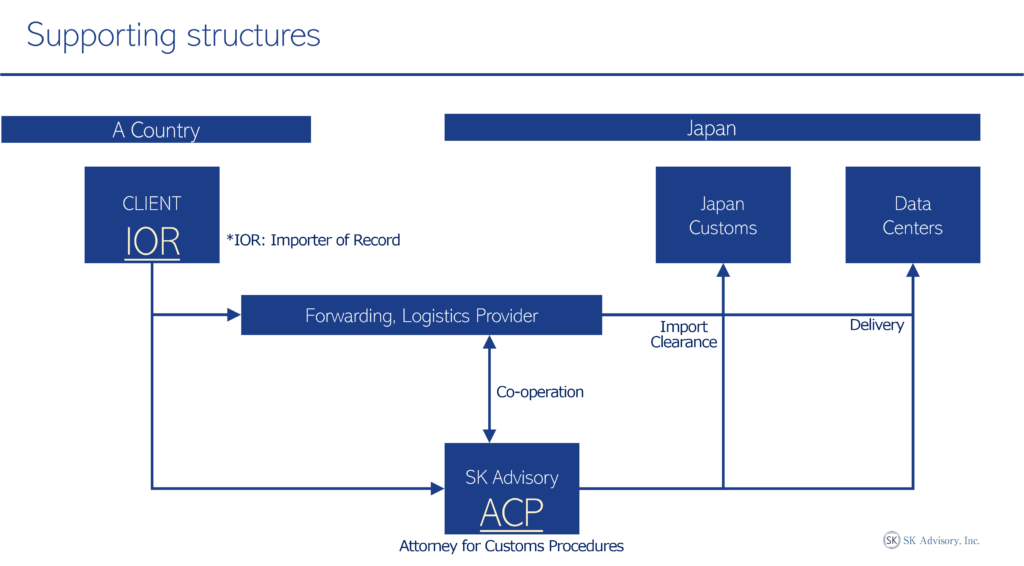
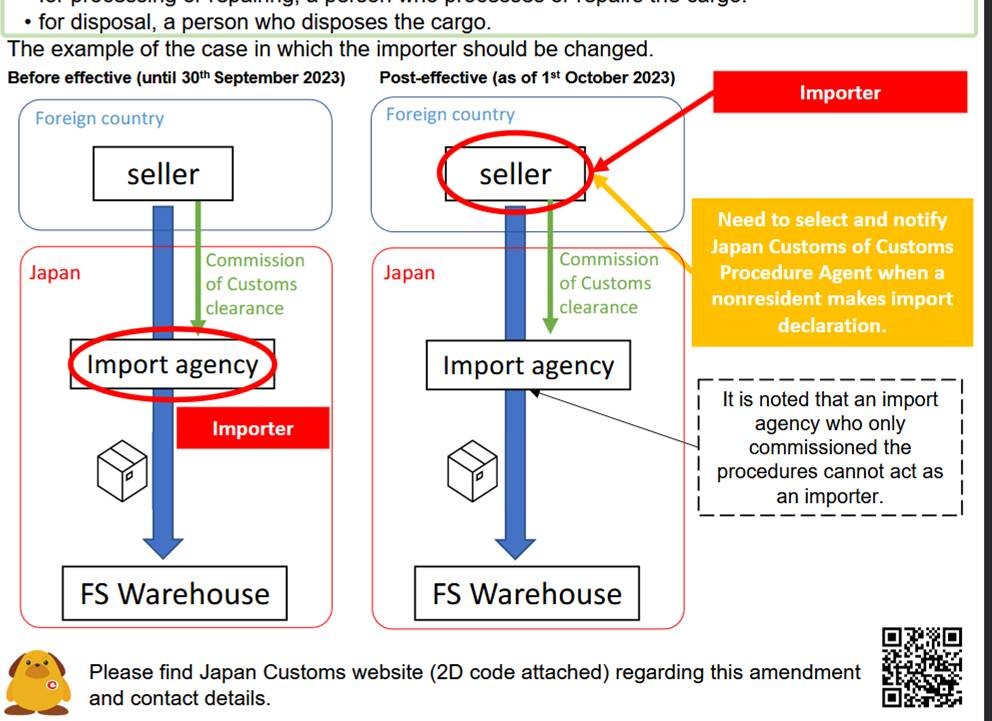
The concept is similar for imports. While a non-resident cannot directly become a Japan Importer of Record (IOR), utilizing an ACP enables a foreign entity to assume the role of an IOR equivalently.
Our ACP Service: The Best Solution for the Japan Exporter of Record (EOR)
ACP is an effective solution for addressing Importer of Record (IOR) and Exporter of Record (EOR) requirements in Japan. Through our ACP service, non-resident entities located outside Japan are able to import and export goods as Non-Resident IOR and EOR.
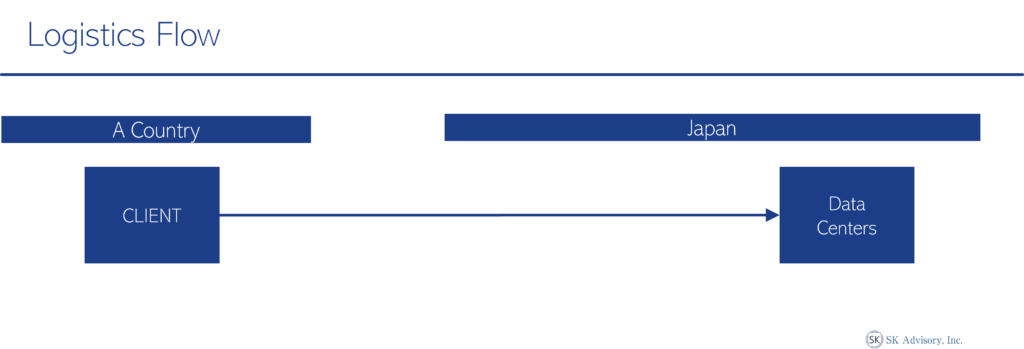
Below is an overview of our basic scope of work, together with a diagram illustrating the operational structure of the ACP service. Once ACP registration is completed, the non-resident entity can act as the Importer of Record (IOR) and Exporter of Record (EOR) in Japan.
Scope of Work – How We Can Assist
- Preparation and filing of all required documents for ACP registration with Japan Customs.
- Coordination and communication with relevant stakeholders, including Japan Customs, logistics providers, and customs brokers to ensure the smooth and compliant import and export procedures.
- Preparation and review of import documentation, including commercial invoices and shipping documents.
*Proper customs clearance requires accurate identification and statement of the shipper, consignee / Exporter of Record (EOR), and Importer of Record (IOR) on B/L, AWB, and Commercial Invoice. We provide practical guidance on correct documentation practices. We also advise on customs valuation (import declaration value) and its supporting documentation, HS classification, and country of origin to ensure compliance with Japanese customs requirements.
- Advisory on customs valuation (import declaration value), HS codes, duty rates, and origin (including advance rulings).
- Import compliance support for regulated products, including Domestic Administrator (sometimes referred to as “Domestic Representative”) Services under the Product Safety Acts (PSE/PSC) and food-related products regulated under the Food Sanitation Act.
- Support for security export control, including list-based classification, catch-all control assessment, and assistance with export license applications to the Ministry of Economy, Trade and Industry (METI).
- Maintenance and retention of records required under the Japan Customs Law.
- Provision of professional trade and customs advisory services to address and resolve issues that may arise during import or export operations.
**Both import and export activities can benefit from the use of an ACP (Attorney for Customs Procedures). This support is applicable in scenarios where a non-resident acts as the Importer of Record (IOR) for imports and as the Exporter of Record (EOR) for exports. 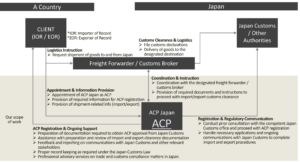
Three Steps to Initiate Shipments Under the ACP Program:
- Quotation Review to Contract Conclusion: Upon receiving your contact details, we will promptly provide a quotation for your review.
- Commencing the Registration of ACP (Attorney for Customs Procedure) to Japan Customs: This process is generally completed in about two weeks.
- Initiation of First Shipment, Import/Export
Track Record – Attorney for Customs Procedures (ACP) Services
We have supported import and export operations in Japan for over 200 clients across more than 40 countries. 
Examples of International Logistics Partners We Have Worked With
We have a proven track record of working with a wide range of logistics providers. As the Attorney for Customs Procedures (ACP), we handle customs-related responsibilities while logistics companies manage transportation and warehousing operations.
- Apex International
- Brink’s
- CEVA Logistics
- Coshipper
- Crane Worldwide Logistics
- DB Schenker
- DGX (Dependable Global Express)
- DHL Express
- DHL Global Forwarding
- Dimerco
- DSV Air & Sea
- Expeditors
- FedEx Express
- FERCAM
- GOTO KAISOTEN Ltd.
- Harumigumi
- Herport
- ICL Logistics
- JAS Forwarding
- Kintetsu Express
- Kokusai Express
- Kuehne + Nagel
- Mitsubishi Logistics
- MOL Logistics
- Nankai Express
- Nippon Express
- OIA Global
- PGS
- Rhenus Group
- Röhlig
- Sankyu
- Sanyo Logistics
- Scan Global Logistics
- Seino Schenker
- SEKO Logistics
- Shin-Ei gumi
- Shiproad
- Sumitomo Warehouse
- UPS
- UPS Supply Chain Solutions
- Yamato Transport
…and many other logistics providers in Japan and around the world.