All posts by ACP JAPAN

Only Importer of Record is Eligible for Deduction of Import JCT – Japan Consumption Tax

In Japan, only the Importer of Record (IOR) is eligible to deduct input (import) consumption tax in principle

The taxpayer liable for the Japan Consumption Tax on Imported Goods from the bonded area, and is considered the importer under Japanese customs law. Under customs law, the importer is defined as the taxpayer, known as the “Importer of Record – IOR” (Customs Law Articles 6 and 7(1), Basic Customs Notification 7-1).

Since the Importer of Record (IOR) is liable for the tax on taxable goods, such an entity, as a business, is eligible to deduct the related Japan Consumption Tax under the Consumption Tax Law (Consumption Tax Law Article 30, Paragraphs 1(3) and (4)).

As of October 1, 2023, amendments to the Customs Regulations have tightened the definition of who can be an “Importer of Record (IOR)”. Only those involved in the transaction, such as buyers who import through sales transactions or those with ownership and disposal rights over the goods, are allowed. Third parties uninvolved in the transaction cannot be Importers of Record (IOR). Foreign corporations without a physical presence in Japan (non-residents) can use our Attorney for Customs Procedures (ACP) service, allowing non-residents themselves to become Importer of Record (IOR) and deduct (or refund) import Consumption Tax.

We have extensive experience in facilitating such tax deductions (or refunds).

Case of Different Substantial Importer and Importer of Record

According to the Tokyo District Court decision on February 20, 2008, “In principle, a tax system where taxable entrepreneurs themselves deduct the taxes paid at the import stage should be assumed. Unless there are special circumstances, it should be understood that a plaintiff who is not the importer of record will not have their consumption tax deductible.” It indicates that tax declarations made in the name of a third party are not intended by law.  We can learn from this court case that only the Importer of Record (IOR) has the right to deduct input tax amounts.  

In very limited cases, substantial importers who are not the formal Importer of Record are allowed to deduct input tax amounts.

Practically, it is appropriate to assume that entities who are not the Importer of Record (IOR) are not allowed to deduct import consumption tax.

An exception that allows the deduction of input tax amounts for those not being the importer of record exists under Basic Consumption Tax Notification 11-1-6 “Handling in Cases Where the Substantial Importer and the Importer of Record Differ”. This directive states that even if the importer of record differs from the substantial importer, the following conditions, if met, allow the substantial importer to deduct the consumption tax paid on their taxable goods:

  1. The substantial importer sells the taxable goods to the importer of record (manufacturer, etc.) for a consideration after importing.
  2. The substantial importer bears the consumption tax amount related to the retrieval of the taxable goods.
  3. The substantial importer preserves the original import permit and receipt of the consumption tax related to the retrieval issued in the name of the importer.

*Please bear in mind that the applicability of this exceptional rule is extremely limited. Therefore, as a general rule, only the Importer of Record (IOR) is eligible to claim input Japan Consumption Tax (JCT).


Japanese Customs System Reform: Clarification of Importer Definitions

Starting October 1, 2023, Japanese Customs has instituted a pivotal reform aimed at addressing the issue of foreign sellers improperly designating third parties (such as forwarders or customs agents) as importers.

This revision necessitates foreign corporations to utilize an Attorney for Customs Procedures (ACP) to assume the role of Importer of Record (IOR) directly in many cases. The practice of merely nominally appointing another entity as the importer is no longer feasible.

Notably, foreign corporations that act as importers themselves, through the engagement of ACP, are eligible for Japan Consumption Tax (JCT) benefits. 

As a dedicated ACP firm, we ensure compliance with the law to facilitate correct import procedures, allowing you to trust us with your importation requirements confidently. We are eager to engage in further discussions with you.

Revisions Effective October 1, 2023:

Definition of the Importer

  • Regarding a cargo imported under import transaction, an importer is equivalent to “a person who imports a cargo” defined in Article 6-1 (1), General Notification of the Customs Act. ….. This means, the Consignee, etc., in the case of imports conducted through normal transactions between an overseas seller and a Japanese buyer
  • In the cases other than above, an importer is a Person Having the Right of Disposal of the import cargo at the time of import declaration. If there is another person who acts on the purpose of the import*, that person is also included :

 In case of a cargo imported:
     – under lease contracts, a person who rents and uses the cargo.
     – for consignment sales, a person who sells the cargo in the name of himself/herself (consignee) by accepting the commission.
     – for processing or repairing, a person who processes or repairs the cargo.
     – for disposal, a person who disposes the cargo.

Importer Defined as the “Person Having the Right of Disposal”

One of the most notable aspects of the amendment is the clarification that the “person having the right of disposal” is regarded as the importer under Japan Customs law. The term “right of disposal” is similar to ownership, but not identical. Although there is no explicit definition in the customs-related legislation, according to Japan Customs, it refers to the authority to decide how the goods will be handled after being released into Japan—for example, whether to sell the goods or to enter into a sales contract.

For additional information, please refer to the following resources:


Our Japan Consumption Tax (JCT) Representative Services

At ACP Japan, we provide a comprehensive one-stop service that covers both customs procedures through the Attorney for Customs Procedures (ACP) and Japan Consumption Tax (JCT) procedures with the National Tax Agency through a designated JCT Tax Representative.

By working closely with our trusted partner tax accountants, we act as your ACP while maintaining close coordination and information sharing with the tax representative.

This collaboration ensures the proper deduction and refund of Japan Consumption Tax paid at the time of importation.  


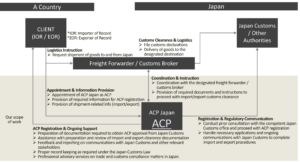
Our ACP Service: The Best Solution for the Japan Importer of Record (IOR) and Exporter of Record (EOR)

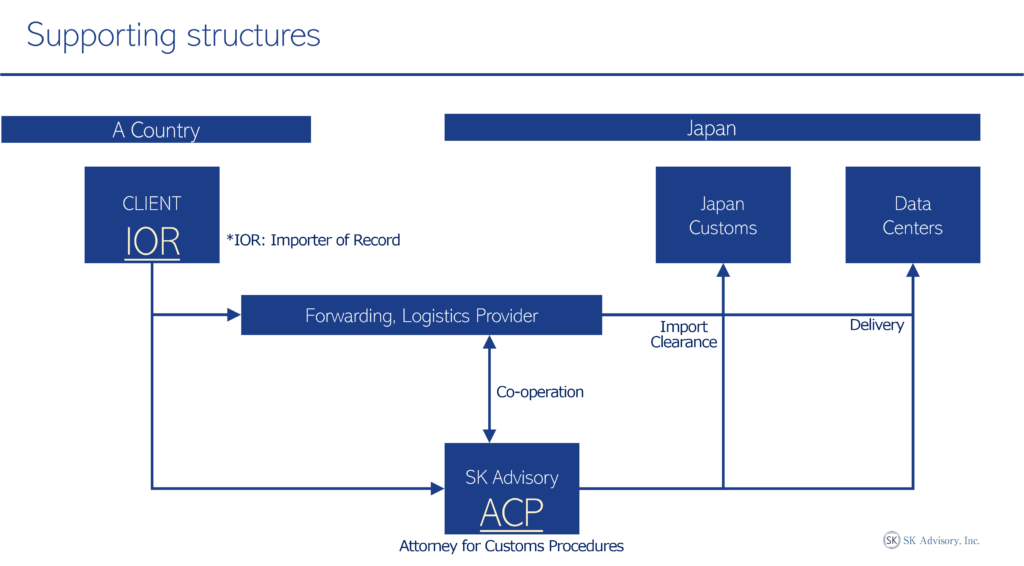
ACP is an effective solution for addressing Importer of Record (IOR) and Exporter of Record (EOR) requirements in Japan. Through our ACP service, non-resident entities located outside Japan are able to import and export goods as Non-Resident IOR and EOR.

Below is an overview of our basic scope of work, together with a diagram illustrating the operational structure of the ACP service. Once ACP registration is completed, the non-resident entity can act as the Importer of Record (IOR) and Exporter of Record (EOR) in Japan.

Scope of Work – How We Can Assist

  • Consultation with Japan Customs to support successful ACP registration.
  • Liaison with relevant stakeholders, including freight forwarders and Japan Customs, to ensure the smooth and compliant import and export of goods.
  • Assistance in preparing and reviewing import and export clearance documentation.
  • Support in the calculation of customs value, in accordance with the Japan Customs Tariff Act.
  • Assistance with advance rulings on HS classification, customs valuation, and rules of origin.
  • Import compliance support for regulated products, including Domestic Administrator (sometimes referred to as “Domestic Representative”) Services under the Product Safety Acts (PSE/PSC) and food-related products regulated under the Food Sanitation Act.
  • Support for security export control, including list-based classification, catch-all control assessment, and assistance with export license applications to the Ministry of Economy, Trade and Industry (METI).
  • Record-keeping support in accordance with Article 95 of the Japan Customs Law.
  • Provision of professional trade and customs advisory services to address and resolve issues that may arise during import or export operations.

**Both import and export activities can benefit from the use of an ACP (Attorney for Customs Procedures). This support is applicable in scenarios where a non-resident acts as the Importer of Record (IOR) for imports and as the Exporter of Record (EOR) for exports.

Three Steps to Initiate Shipments Under the ACP Program:

  1. Quotation Review to Contract Conclusion: Upon receiving your contact details, we will promptly provide a quotation for your review.
  2. Commencing the Registration of ACP (Attorney for Customs Procedures) to Japan Customs: This process is generally completed in about two weeks.
  3. Initiation of First Shipment, Import/Export


Track Record – Attorney for Customs Procedures (ACP) Services

We have supported import and export operations in Japan for over 200 clients across more than 40 countries.  

Examples of International Logistics Partners We Have Worked With

We have a proven track record of working with a wide range of logistics providers. As the Attorney for Customs Procedures (ACP), we handle customs-related responsibilities while logistics companies manage transportation and warehousing operations.

  • Apex International
  • Brink’s
  • CEVA Logistics
  • Coshipper
  • Crane Worldwide Logistics
  • DB Schenker
  • DGX (Dependable Global Express)
  • DHL Express
  • DHL Global Forwarding
  • Dimerco
  • DSV Air & Sea
  • Expeditors
  • FedEx Express
  • FERCAM
  • GOTO KAISOTEN Ltd.
  • Harumigumi
  • Herport
  • ICL Logistics
  • JAS Forwarding
  • Kintetsu Express
  • Kokusai Express
  • Kuehne + Nagel
  • Mitsubishi Logistics
  • MOL Logistics
  • Nankai Express
  • Nippon Express
  • OIA Global
  • PGS
  • Rhenus Group
  • Röhlig
  • Sankyu
  • Sanyo Logistics
  • Scan Global Logistics
  • Seino Schenker
  • SEKO Logistics
  • Shin-Ei gumi
  • Shiproad
  • Sumitomo Warehouse
  • UPS
  • UPS Supply Chain Solutions
  • Yamato Transport

…and many other logistics providers in Japan and around the world.  

Japan Security Export Control – Compliance Establishment

Exporters shipping goods from Japan are required to verify whether the exported goods or transactions are subject to security export control regulations. Exporters must prepare the necessary classification documents (Certificates of Non-Applicability/Applicability) for export customs clearance and, where necessary, obtain permission from the Ministry of Economy, Trade and Industry.

Compliance with list control and catch-all control regulations, as defined in the Foreign Exchange and Foreign Trade Act, Export Order, Foreign Exchange Order, and the Order Concerning Export, etc., is mandatory. There are also penalties for non-compliance.

Our company supports many foreign corporations (exporters and importers) based outside Japan as an Attorney for Custms Procedures (ACP). Acting as an ACP for the foreign corporations, we handle customs procedures as well as tasks required under security export control, including determination of list control compliance, transaction reviews under catch-all regulations, and applications for permits from the Ministry of Economy, Trade and Industry.

With the increase in export cases, we have established a business process for security export control that meets the “Compliance Standards for Exporters, etc.: I Standards of Compliance for Exporters, II Standards of Compliance for Export of Controlled Items,” as stipulated by law.

As a professional Attorney for Customs Procedures, we are committed to properly adhering to various compliance requirements.

Reference: Ministry of Economy, Trade and Industry, Security Trade Control Guidance (Link)


Various Laws to Consider When Exporting

Customs Law Related:

  – Customs Law: Prohibited items (narcotics, child pornography, items infringing intellectual property rights, copies, imitations, etc.).

Security Trade Control (Export Control) Related:

  – Export Trade Control Order: Goods
  – Foreign Exchange Order: Services (technology)

Other Laws Related:

  – Cultural Property Protection Law
  – Wildlife Protection and Hunting Law
  – Livestock Infectious Disease Prevention Law
  – Rabies Prevention Law
  – Plant Quarantine Law
  – Road Transport Vehicle Law
  – Narcotics and Psychotropic Drugs Control Law, Cannabis Control Law, Opium Law, Stimulants Control Law

Framework of Security Trade Control Regulations

1) List Control:

Prohibited goods and technologies that should not be exported (advanced technology, dual-use risks):
  – Goods: Items 1 to 15 in Schedule 1 of the Export Trade Control Order.
  – Services: Items 1 to 15 in Schedule of the Foreign Exchange Order.

2) Catch-All Controls:

Prohibited export recipients (UN arms embargo countries or concerning individuals/organizations):
  – Goods: Item 16 in Schedule 1 of the Export Trade Control Order “All except food and wood.”
  – Services: Item 16 in Schedule of the Foreign Exchange Order “Technologies related to all except food and wood.”

Penalties Related to Export Control

Criminal Penalties (Maximum):

  – Up to 10 years imprisonment
  – Fine up to 1 billion yen (for corporations)
  – Fine up to 30 million yen (for individuals)

Administrative Penalties:

  – Prohibition on exporting goods or providing technology for up to 3 years
  – Prohibition from taking executive positions in other companies

Export Control Procedures

Step-1: Yes-No Determination

Determine whether the goods or technology to be exported falls under the “List Control” goods etc.

  – Specific items are listed in “Schedule 1 of the Export Order” or “Schedule of the Foreign Exchange Order”, and their specific specifications are confirmed in “Goods etc. Ministerial Ordinance”.

  – Item verification: Match export items against the contents of Schedule 1 of the Export Order or the Foreign Exchange Order. 

  – Specification verification: Match against the Goods etc. Ministerial Ordinance. The “Goods & Technology Matrix Table” on the Ministry of Economy, Trade and Industry website is helpful for matching export item specifications.

  – Using the “Item-by-Item Comparison Table” or “Parameter Sheet” can be more efficient. Available for purchase from the CISTEC website.

  – If not applicable, a non-applicable certificate is created.

Step-2: Transaction Examination

Check who the counterpart is (inquirer, end-user), and what the uses are to decide whether to proceed with the transaction.

(1) “End-Use & End-User” verification and decision.
(2) Decision on the applicability of “Exception Provisions” (such as gratuitous exception, small amount exception).
(3) Decision on the applicability of “General Permit”.
(4) Check concerning Catch-All Controls.
  → If necessary, apply for individual permission from the Ministry of Economy, Trade and Industry.

Step-3: Shipping Management, Export

  – Ensure that the Yes-No Determination and Transaction Examination are properly completed.
  – Verify that the goods or technology to be exported is the same as what was determined and examined.
  – If a permit is required for export, ensure it is obtained.

Export Permit Application

When exporting goods or providing technology that falls under regulation, it is necessary to obtain prior permission from the Ministry of Economy, Trade and Industry (normally, electronic application through NACCS).  


Compliance with Export Control Standards (enacted April 2010)

– Those engaged in exporting or providing technology as a business (exporters etc.) must comply with the Exporter Compliance Standards according to Article 55-10, Paragraph 4 of the Foreign Exchange Law.  

– Exporters etc. dealing with security-sensitive specified important goods (List Control items) must comply with Standards I and II. Those not dealing with such items must comply with Standard I only.  

Tips for Export Management (Utilization of Forms)

By establishing and utilizing company-specific forms (formats), export management tasks can be securely implemented, and illegal exports can be prevented.

Form Examples:  

– Yes-No Determination: Yes-No Determination Form  

– Transaction Examination: Use Checklist, End-User Checklist, Clear Guideline Sheet, Transaction Examination Form  

– Shipping Management: Shipping Checklist  

Reference: Ministry of Economy, Trade and Industry Security Trade Control Guidance Materials  

Gratuitous Exception (exemptions where permit application is waived)

Gratuitous Notice: Goods imported gratuitously as specified by the Minister of Economy, Trade, and Industry under Article 4, Paragraph 1, Item Ho and He of the Export Trade Control Order.

Goods imported gratuitously and subsequently returned without consideration (9 cases extracted):

– Goods exported from Japan that are repaired in Japan and re-exported.
– Goods exhibited at exhibitions held in Japan from abroad.
– Goods imported through an ATA Carnet for temporary import.
– Items carried by persons temporarily entering and leaving the country for personal use.
– Goods imported for the purpose of transporting other goods.

Goods to be exported gratuitously as specified (7 cases extracted):

– Goods exported by the International Emergency Assistance Team for use in international emergency assistance activities.
– Goods exported by experts dispatched by the Japan International Cooperation Agency for their use.
– Items carried by persons temporarily leaving the country for personal use.
– Goods exported for the purpose of transporting other goods.

Small Amount Exception (exemptions where permit application is waived)

(1) Items under Items 1-4 of Schedule 1 of the Export Order: No application of small amount exception.
 (2) Goods under Items 5-13 of Schedule 1 of the Export Order, except below (3): Below 1 million yen.
 (3) Goods specified by the Minister of Economy, Trade, and Industry under the provisions of Schedule 3, Item 3 of the Export Order (Schedule 3, Item 3 Notice): Below 50,000 yen.
 (4) Goods under Item 14 of Schedule 1 of the Export Order: No application of small amount exception.
 (5) Goods under Item 15 of Schedule 1 of the Export Order: Below 50,000 yen.
 (6) Goods under Item 16 of Schedule 1 of the Export Order: No application of small amount exception.

  Note: If the destination is a concern country (North Korea, Iran, Iraq, etc.), the small amount exception does not apply.

U.S. Export Control Regulations – EAR (Export Administration Regulations)

A feature of the U.S. EAR is its “extraterritorial application”. When U.S.-origin goods or technology exported from the U.S. are re-exported from the importing country, in addition to review under the domestic laws of that country, an export review based on U.S. law is also required. If applicable, permission must be obtained from the U.S. government.

 Step-1: Check if the item is subject to EAR regulations (CCL – Commerce Control List). 
 Step-2: Check if an ECCN (Export Control Classification Number) exists.
 Step-3: Check if re-export permission is required.
 Step-4: Check if a license exception is applicable.
   → If necessary, apply for permission from the U.S. government.


Our Service – Attorney for Customs Procedures (ACP) for Exporter of Record (EOR)


What is an Exporter of Record (EOR) in Japan?

For exporting goods from Japan, it is required to designate a Japan Exporter of Record (EOR). The EOR must typically be a Japanese resident person or entity, bearing responsibility for compliance with export-related regulations. Japan Customs mandates that the EOR be based in Japan, disallowing foreign entities from fulfilling this role directly.


What is Japan ACP – Attorney for Customs Procedures

Nevertheless, foreign entities can engage in exporting from Japan by appointing an Attorney for Customs Procedure (ACP). This appointment allows the foreign enties to operate as a Non-Resident Exporter (EOR), enabling them to manage exports independently.

The concept is similar for imports. While a non-resident cannot directly become a Japan Importer of Record (IOR), utilizing an ACP enables a foreign entity to assume the role of an IOR equivalently.


Our ACP Service: The Best Solution for the Japan Exporter of Record (EOR)

ACP is an effective solution for addressing Importer of Record (IOR) and Exporter of Record (EOR) requirements in Japan. Through our ACP service, non-resident entities located outside Japan are able to import and export goods as Non-Resident IOR and EOR.

Below is an overview of our basic scope of work, together with a diagram illustrating the operational structure of the ACP service. Once ACP registration is completed, the non-resident entity can act as the Importer of Record (IOR) and Exporter of Record (EOR) in Japan.

Scope of Work – How We Can Assist

  • Consultation with Japan Customs to support successful ACP registration.
  • Liaison with relevant stakeholders, including freight forwarders and Japan Customs, to ensure the smooth and compliant import and export of goods.
  • Assistance in preparing and reviewing import and export clearance documentation.
  • Support in the calculation of customs value, in accordance with the Japan Customs Tariff Act.
  • Assistance with advance rulings on HS classification, customs valuation, and rules of origin.
  • Import compliance support for regulated products, including Domestic Administrator (sometimes referred to as “Domestic Representative”) Services under the Product Safety Acts (PSE/PSC) and food-related products regulated under the Food Sanitation Act.
  • Support for security export control, including list-based classification, catch-all control assessment, and assistance with export license applications to the Ministry of Economy, Trade and Industry (METI).
  • Record-keeping support in accordance with Article 95 of the Japan Customs Law.
  • Provision of professional trade and customs advisory services to address and resolve issues that may arise during import or export operations.

**Both import and export activities can benefit from the use of an ACP (Attorney for Customs Procedures). This support is applicable in scenarios where a non-resident acts as the Importer of Record (IOR) for imports and as the Exporter of Record (EOR) for exports.

Three Steps to Initiate Shipments Under the ACP Program:

  1. Quotation Review to Contract Conclusion: Upon receiving your contact details, we will promptly provide a quotation for your review.
  2. Commencing the Registration of ACP (Attorney for Customs Procedure) to Japan Customs: This process is generally completed in about two weeks.
  3. Initiation of First Shipment, Import/Export


Track Record – Attorney for Customs Procedures (ACP) Services

We have supported import and export operations in Japan for over 200 clients across more than 40 countries.  

Examples of International Logistics Partners We Have Worked With

We have a proven track record of working with a wide range of logistics providers. As the Attorney for Customs Procedures (ACP), we handle customs-related responsibilities while logistics companies manage transportation and warehousing operations.

  • Apex International
  • Brink’s
  • CEVA Logistics
  • Coshipper
  • Crane Worldwide Logistics
  • DB Schenker
  • DGX (Dependable Global Express)
  • DHL Express
  • DHL Global Forwarding
  • Dimerco
  • DSV Air & Sea
  • Expeditors
  • FedEx Express
  • FERCAM
  • GOTO KAISOTEN Ltd.
  • Harumigumi
  • Herport
  • ICL Logistics
  • JAS Forwarding
  • Kintetsu Express
  • Kokusai Express
  • Kuehne + Nagel
  • Mitsubishi Logistics
  • MOL Logistics
  • Nankai Express
  • Nippon Express
  • OIA Global
  • PGS
  • Rhenus Group
  • Röhlig
  • Sankyu
  • Sanyo Logistics
  • Scan Global Logistics
  • Seino Schenker
  • SEKO Logistics
  • Shin-Ei gumi
  • Shiproad
  • Sumitomo Warehouse
  • UPS
  • UPS Supply Chain Solutions
  • Yamato Transport

…and many other logistics providers in Japan and around the world.  


Japan JCT Tax Obligations for Foreign Corporations with a Capital of Over 10 Million Yen (Amendments to the Consumption Tax Law, April 2024)

Consumption tax in Japan applies to the transfer of assets conducted domestically by businesses, which means that non-residents and foreign corporations are also subject to consumption tax and are obliged to pay it if they transfer assets within Japan.

In some cases, such as exempt businesses, it may not be necessary to pay the tax to the national tax office.

However, the following are examples where one cannot qualify as an exempt business and must file for consumption tax:

Examples where JCT tax filing is required:

  1. Qualified JCT Invoice Issuers
  2. Businesses with taxable sales exceeding JPY 10 million in the base period (roughly speaking, the fiscal year two years prior) for the taxable period
  3. Businesses with taxable sales exceeding JPY 10 million for the specified period (roughly speaking, the first six months of the previous fiscal year, etc.)
  4. New corporations (including specified newly established corporations) with capital or investment of JPY 10 million or more for taxable periods without a base period
  5. Businesses that have made the election to become a taxable enterprise

※ With the amendments to the Consumption Tax Law in April 2024, regarding point 4, if a foreign corporation has capital or contributions exceeding 10 million yen when they start business operations in Japan (including specified newly established corporations), regardless of when the corporation was established abroad, they are obliged to pay taxes and declare from the fiscal year they start operations in Japan (applicable for taxable periods starting after October 1, 2024).

We specialize in navigating complex issues at the intersection of customs procedures and taxation—an area where our ability to offer practical, comprehensive support from both perspectives sets us apart. Understanding the close relationship between customs duties and national taxes (especially, Japan Consumption Tax – JCT), and addressing both in an integrated manner, is crucial in the context of international trade.


What Is a JCT Tax Representative and Why Is It Required?

When a non-resident foreign entity becomes subject to Japan’s Consumption Tax (JCT), it is required to appoint a JCT Tax Representative (Tax Agent).

If a non-resident company sells goods to customers in Japan, it typically collects 10% consumption tax on those sales. This collected JCT must be reported and submitted to the Japanese National Tax Office, unless the entity qualifies as a tax-exempt business. (See: “Are we a Tax-Exempt Business?”)

If the entity is JCT-liable—or voluntarily registers as a taxable entity, such as by obtaining a Qualified Invoice Issuer Number—it must appoint a JCT Tax Representative to handle all tax-related procedures in Japan, including JCT tax filings.

In the JCT tax return process, the paid import JCT can be offset against the collected JCT.

  • If the import JCT exceeds the collected amount, the difference may be refunded.
  • If the collected JCT exceeds the import amount, the difference must be paid to the tax office.

A JCT Tax Representative is legally required to manage this process on behalf of the foreign entity.

Please note:

The JCT Tax Representative is distinct from the Attorney for Customs Procedures (ACP), which is appointed for customs clearance purposes.

  • ACP = Customs representative
  • JCT Tax Representative = Tax representative

Our Japan Consumption Tax (JCT) Representative Services

At ACP Japan, we provide a comprehensive one-stop service that covers both customs procedures through the Attorney for Customs Procedures (ACP) and Japan Consumption Tax (JCT) procedures with the National Tax Agency through a designated JCT Tax Representative.

By working closely with our trusted partner tax accountants, we act as your ACP while maintaining close coordination.


JCT Compliance

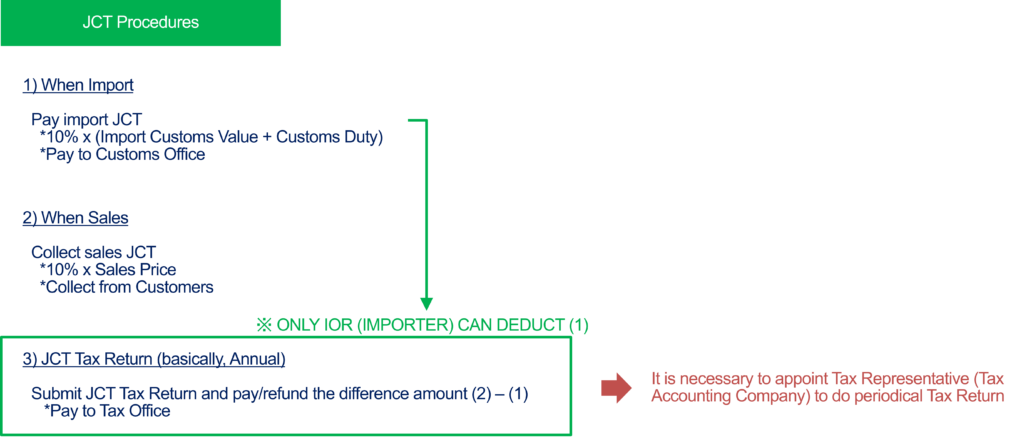
Understanding the handling of JCT (such as payment of import JCT, collection of sales JCT from customers, and JCT returns) is crucial to avoid significant cost burdens. This is a vital aspect, so please ensure a thorough understanding to determine the most optimal business model.

Basic procedure

For non-resident entities (Company-A) that import and sell goods to customers in Japan, the standard procedure involves three steps:

  1. Pay import Japan Consumption Tax (JCT) to a customs office, 10% of the import customs value when Company-A imports goods.  <PAY TO CUSTOMS OFFICE>
  2. Obtain JCT from customers in Japan, 10% of the sales price when Company-A sells goods.
  3. Submit JCT tax return and pay the difference amount (2) – (1) to a tax office periodically  <PAY TO TAX OFFICE (different authority from Customs Office)>

Note: Using ACP to become the importer (IOR) is essential for JCT deductions and refunds. If another company acts as the IOR, you cannot deduct the input tax (step 1), and must pay the entire VAT collected (step 2) to the national tax authorities, leading to significant costs.

If you are a JCT-exempt business, the process ends at steps 1 and 2. For taxable businesses or invoice-registered businesses, step 3 (Final Tax Return) is obligatory.

In the Final Tax Return (step 3), if the JCT paid (step 1) exceeds the provisional JCT received (step 2), the difference is refunded. Conversely, if the provisional JCT received (step 2) exceeds the JCT paid (step 1), the difference must be paid to the tax office.

Why IMPORTER is important?

It is crucial to note that only the IMPORTER can deduct the import consumption tax at the time of tax filing. (= Deduct above (1) from (2) )

If Company-A uses another company to act IMPORTER, then Company-A can’t do above (3). Company-A has to pay all the amount of (2) to a tax office.

However, if Company-A imports goods using the Attorney for Customs Procedure (ACP), it becomes the Importer and can deduct the import consumption tax when filing the JCT tax return. In this case, Company-A only needs to pay the difference between the JCT collected from customers and the import JCT (2) – (1) paid to the Tax Office.


Appoint a tax accounting firm as Tax Representative / Tax Agent

Apart from utilizing ACP, when filing taxes in Japan (3), Company-A must appoint a Tax Representative. The Tax Representative will handle JCT tax registration and JCT filings with the tax office on behalf of the non-resident entity. ACP Japan can introduce our partner tax accounting company that can act as the Tax Representative.


Are we a Tax-Exempt Business?

Tax Filing Obligations of Nonresidents and Foreign Corporations

First, the consumption tax received from customers in Step 2 above should basically be paid to the national tax office. Consumption tax is imposed on transfers, etc. of assets made in Japan. Therefore, even if a nonresident or foreign corporation transfers assets in Japan, it is subject to consumption tax and is obligated to pay the tax.

In some cases, such as exempt businesses, it may not be necessary to pay the tax to the national tax office.

However, the following are examples where one cannot qualify as an exempt business and must file for consumption tax:

Examples of Entities Required to File JCT Tax Returns (Non-Exempt Businesses)

  • Qualified Invoice Issuers:
    Businesses registered as qualified invoice issuers under Japan’s invoice system.
  • Businesses with Taxable Sales Exceeding JPY 10 Million During the Base Period:
    Entities whose taxable sales in Japan during the base period (generally the fiscal year two years prior) exceed JPY 10 million.
  • Businesses with Taxable Sales Exceeding JPY 10 Million During the Specific Period:
    Entities whose taxable sales in Japan during the specific period (generally the first six months of the previous fiscal year) exceed JPY 10 million.
  • Newly Established Corporations with Capital of JPY 10 Million or More:
    Newly established corporations (including certain newly established corporations) with capital or investment of JPY 10 million or more during a taxable period without a base period.
  • Foreign Corporations with Capital of JPY 10 Million or More Deemed to Have No Base Period: (Applicable to taxable periods starting on or after October 1, 2024) *
    Foreign corporations without a base period and with capital or investment of JPY 10 million or more at the start of the fiscal year are not exempt from consumption tax obligations.
  • Businesses Opting for Taxable Enterprise Status:
    Entities that voluntarily select to be treated as taxable enterprises.

Disclaimer: The above outlines the general principles of Japan’s consumption tax obligations. Each company’s specific tax liability should be confirmed by consulting with a licensed tax accountant.

If you’re an Exempted entity

During the exempt term, a new entity is not required to file tax returns. As long as your entity has exempt status, you are only required to:
(1) Pay 10% tax of the import customs value when you import goods.
(2) Collect 10% of the sales price when you sell goods.
That’s all. You can enjoy the difference (2) – (1).


Can Tax-Exempt Businesses Receive Refunds?

Yes, however, a final JCT tax return (Step 3) is required in order to receive a refund. Even if your business is initially classified as tax-exempt, you may voluntarily register as a taxable entity and begin filing JCT tax returns to claim refunds for import JCT you have paid. 

This can be beneficial, for example, when the JCT paid at import (Step 1) exceeds the JCT collected from customers (Step 2). In such cases, the difference may be refunded by the National Tax Office.

Importantly, to claim a refund or deduction for import JCT, the use of an Attorney for Customs Procedures (ACP) is essential for non-resident businesses—only ACP-registered importers are eligible for JCT recovery.


Our ACP Service: The Best Solution for the Japan Importer of Record (IOR) and Exporter of Record (EOR)

ACP is an effective solution for addressing Importer of Record (IOR) and Exporter of Record (EOR) requirements in Japan. Through our ACP service, non-resident entities located outside Japan are able to import and export goods as Non-Resident IOR and EOR.

Below is an overview of our basic scope of work, together with a diagram illustrating the operational structure of the ACP service. Once ACP registration is completed, the non-resident entity can act as the Importer of Record (IOR) and Exporter of Record (EOR) in Japan.

Scope of Work – How We Can Assist

  • Consultation with Japan Customs to support successful ACP registration.
  • Liaison with relevant stakeholders, including freight forwarders and Japan Customs, to ensure the smooth and compliant import and export of goods.
  • Assistance in preparing and reviewing import and export clearance documentation.
  • Support in the calculation of customs value, in accordance with the Japan Customs Tariff Act.
  • Assistance with advance rulings on HS classification, customs valuation, and rules of origin.
  • Import compliance support for regulated products, including Domestic Administrator (sometimes referred to as “Domestic Representative”) Services under the Product Safety Acts (PSE/PSC) and food-related products regulated under the Food Sanitation Act.
  • Support for security export control, including list-based classification, catch-all control assessment, and assistance with export license applications to the Ministry of Economy, Trade and Industry (METI).
  • Record-keeping support in accordance with Article 95 of the Japan Customs Law.
  • Provision of professional trade and customs advisory services to address and resolve issues that may arise during import or export operations.

**Both import and export activities can benefit from the use of an ACP (Attorney for Customs Procedures). This support is applicable in scenarios where a non-resident acts as the Importer of Record (IOR) for imports and as the Exporter of Record (EOR) for exports.

Three Steps to Initiate Shipments Under the ACP Program:

  1. Quotation Review to Contract Conclusion: Upon receiving your contact details, we will promptly provide a quotation for your review.
  2. Commencing the Registration of ACP (Attorney for Customs Procedures) to Japan Customs: This process is generally completed in about two weeks.
  3. Initiation of First Shipment, Import/Export


Track Record – Attorney for Customs Procedures (ACP) Services

We have supported import and export operations in Japan for over 200 clients across more than 40 countries.  

Examples of International Logistics Partners We Have Worked With

We have a proven track record of working with a wide range of logistics providers. As the Attorney for Customs Procedures (ACP), we handle customs-related responsibilities while logistics companies manage transportation and warehousing operations.

  • Apex International
  • Brink’s
  • CEVA Logistics
  • Coshipper
  • Crane Worldwide Logistics
  • DB Schenker
  • DGX (Dependable Global Express)
  • DHL Express
  • DHL Global Forwarding
  • Dimerco
  • DSV Air & Sea
  • Expeditors
  • FedEx Express
  • FERCAM
  • GOTO KAISOTEN Ltd.
  • Harumigumi
  • Herport
  • ICL Logistics
  • JAS Forwarding
  • Kintetsu Express
  • Kokusai Express
  • Kuehne + Nagel
  • Mitsubishi Logistics
  • MOL Logistics
  • Nankai Express
  • Nippon Express
  • OIA Global
  • PGS
  • Rhenus Group
  • Röhlig
  • Sankyu
  • Sanyo Logistics
  • Scan Global Logistics
  • Seino Schenker
  • SEKO Logistics
  • Shin-Ei gumi
  • Shiproad
  • Sumitomo Warehouse
  • UPS
  • UPS Supply Chain Solutions
  • Yamato Transport

…and many other logistics providers in Japan and around the world.  


Urgent Compliance Alert for E-Commerce Sellers: Avoid Penalties with Japan’s New Import Regulations

As previously mentioned in another article (“Announcement from Japan Customs | Mandatory to Use ACP in Many Cases – Attorney for Customs Procedures”), from October 2023, overseas sellers, especially those on e-commerce platforms like Amazon, Rakuten, and Shopify, are now required to utilize ACP and become the Importer of Record (IOR) themselves. Therefore, schemes involving designating other Japanese corporations as the IOR are no longer feasible. Despite clear directives to this effect, we observe certain IOR businesses providing unauthorized IOR services.

The prevalence of such questionable practices necessitates this article as a cautionary note. Sellers operating in Japan must strive to understand and comply with the correct legal framework and avoid unnecessary penalties.

Problematic Practices – Violation of Customs Laws

There are instances where transactions seem to exist between overseas businesses and Japanese IORs (who are merely importers in name), with manipulated documents like invoices reflecting undervalued declared prices for customs clearance. In reality, these goods are not directly shipped to fulfillment centers like Amazon but temporarily stored in domestic warehouses. Here, they are labeled before being sent to the final fulfillment destination. This scheme aims to avoid detection by customs as e-commerce products. Such actions are illegal and not in compliance with the law, and I strongly urge an immediate cessation of these practices.

Importing through illegal schemes often leads to undervalued import declarations. Even if customs clearance is initially granted, subsequent Post Clearance Audit by customs can lead to substantial penalties. Legally, the IOR is liable for these payments, which can lead to disputes between overseas sellers and IOR businesses. Typically, the financial burden of import duties and taxes falls on the overseas sellers, making conflicts predictable.

Both the uninformed overseas businesses using these illegal schemes and the IOR operators bear responsibility.

Observing extremely low prices for products by overseas sellers on e-commerce platforms like Amazon often gives an impression of an unfair competitive environment. Legitimate overseas businesses pay appropriate taxes and add these costs to their selling prices, putting them at a disadvantage against sellers who avoid proper tax payments. This unfairness is precisely why the customs system was revised in October 2023.

For businesses with low compliance awareness, the issues likely extend beyond just declared values. Often, they might also be non-compliant with intellectual property laws and other regulations.


Concerns Over Cost Impact of Customs Valuation/Import Declarations

When overseas sellers import goods for e-commerce into Japan, whether through ACP or as another IOR company, there is no “import transaction” with a Japanese buyer, leading to the exceptional determination method for declared import values, typically based on the domestic selling price.

There are concerns about high valuation leading to excessive duties and taxes. However, this is a determination method based on the Customs Tariff Law, which must be adhered to. The cost impact of the valuation is not as significant as often feared.

The taxes on import are mainly customs duties and consumption tax. Japan’s import tariffs are relatively low on a global scale, and many industrial products are duty-free. As for consumption tax, which is a uniform 10%, it is an indirect tax borne by the final consumer, not a cost for the overseas seller. Taxable businesses regularly file consumption tax returns to the tax office, adjusting the tax paid on imports against the tax collected from sales, neutralizing the cost impact. However, this necessitates that the overseas business itself becomes the importer, achievable only through using ACP.

With the start of the consumption tax invoice system in October 2023, many overseas businesses might have registered as qualified invoice-issuing entity. For B2C businesses, registration as a qualified invoice issuer is not always necessary, but many companies seem to register without fully understanding the system. I recommend that overseas businesses seek advice from qualified professionals to navigate these changes correctly.

As seasoned experts in customs and trade facilitation, we at ACP Japan are here to navigate these complexities on your behalf. Our approach, grounded in professionalism and profound regulatory knowledge, ensures a seamless, compliant, and strategic entry into Japan’s vibrant market.

We invite you to reach out to us — let’s discuss how we can support your business’s successful and compliant expansion into Japan. Your peace of mind is our top priority.

We look forward to your inquiry!


Our ACP Service: The Best Solution for the Japan Importer of Record (IOR) and Exporter of Record (EOR)

ACP is an effective solution for addressing Importer of Record (IOR) and Exporter of Record (EOR) requirements in Japan. Through our ACP service, non-resident entities located outside Japan are able to import and export goods as Non-Resident IOR and EOR.

Below is an overview of our basic scope of work, together with a diagram illustrating the operational structure of the ACP service. Once ACP registration is completed, the non-resident entity can act as the Importer of Record (IOR) and Exporter of Record (EOR) in Japan.

Scope of Work – How We Can Assist

  • Consultation with Japan Customs to support successful ACP registration.
  • Liaison with relevant stakeholders, including freight forwarders and Japan Customs, to ensure the smooth and compliant import and export of goods.
  • Assistance in preparing and reviewing import and export clearance documentation.
  • Support in the calculation of customs value, in accordance with the Japan Customs Tariff Act.
  • Assistance with advance rulings on HS classification, customs valuation, and rules of origin.
  • Import compliance support for regulated products, including Domestic Administrator (sometimes referred to as “Domestic Representative”) Services under the Product Safety Acts (PSE/PSC) and food-related products regulated under the Food Sanitation Act.
  • Support for security export control, including list-based classification, catch-all control assessment, and assistance with export license applications to the Ministry of Economy, Trade and Industry (METI).
  • Record-keeping support in accordance with Article 95 of the Japan Customs Law.
  • Provision of professional trade and customs advisory services to address and resolve issues that may arise during import or export operations.

**Both import and export activities can benefit from the use of an ACP (Attorney for Customs Procedures). This support is applicable in scenarios where a non-resident acts as the Importer of Record (IOR) for imports and as the Exporter of Record (EOR) for exports.

Three Steps to Initiate Shipments Under the ACP Program:

  1. Quotation Review to Contract Conclusion: Upon receiving your contact details, we will promptly provide a quotation for your review.
  2. Commencing the Registration of ACP (Attorney for Customs Procedures) to Japan Customs: This process is generally completed in about two weeks.
  3. Initiation of First Shipment, Import/Export


Japanese Customs System Reform: Clarification of Importer Definitions

Starting October 1, 2023, Japanese Customs has instituted a pivotal reform aimed at addressing the issue of foreign sellers improperly designating third parties (such as forwarders or customs agents) as importers.

This revision necessitates foreign corporations to utilize an Attorney for Customs Procedures (ACP) to assume the role of Importer of Record (IOR) directly in many cases. The practice of merely nominally appointing another entity as the importer is no longer feasible.

Notably, foreign corporations that act as importers themselves, through the engagement of ACP, are eligible for Japan Consumption Tax (JCT) benefits. (link: Consumption Tax Treatment and Benefits of Using ACP).

As a dedicated ACP firm, we ensure compliance with the law to facilitate correct import procedures, allowing you to trust us with your importation requirements confidently. We are eager to engage in further discussions with you.

Revisions Effective October 1, 2023:

Definition of the Importer

  • Regarding a cargo imported under import transaction, an importer is equivalent to “a person who imports a cargo” defined in Article 6-1 (1), General Notification of the Customs Act.    ….. This means, the Consignee, etc., in the case of imports conducted through normal transactions between an overseas seller and a Japanese buyer
  • In the cases other than above, an importer is a person who has a right to disposition of the import cargo at the time of import declaration. If there is another person who acts on the purpose of the import*, that person is also included :

     In case of a cargo imported:
     – under lease contracts, a person who rents and uses the cargo.
     – for consignment sales, a person who sells the cargo in the name of himself/herself (consignee) by accepting the commission.
     – for processing or repairing, a person who processes or repairs the cargo.
     – for disposal, a person who disposes the cargo.

For additional information, please refer to the following resources:


Track Record – Attorney for Customs Procedures (ACP) Services

We have supported import and export operations in Japan for over 200 clients across more than 40 countries.


Examples of International Logistics Partners We Have Worked With

We have a proven track record of working with a wide range of logistics providers. As the Attorney for Customs Procedures (ACP), we handle customs-related responsibilities while logistics companies manage transportation and warehousing operations.

  • American Overseas Transport (AOT)
  • Apex International
  • Brink’s
  • CEVA Logistics
  • Coshipper
  • Crane Worldwide Logistics
  • DB Schenker
  • DGX (Dependable Global Express)
  • DHL Express
  • DHL Global Forwarding
  • Dimerco
  • DSV Air & Sea
  • Expeditors
  • FedEx Express
  • FERCAM
  • GOTO KAISOTEN Ltd.
  • Harumigumi
  • Herport
  • ICL Logistics
  • JAS Forwarding
  • Kintetsu Express
  • Kokusai Express
  • Kuehne + Nagel
  • Mitsubishi Logistics
  • MOL Logistics
  • Nankai Express
  • Nippon Express
  • OIA Global
  • PGS
  • Rhenus Group
  • Röhlig
  • Sankyu
  • Sanyo Logistics
  • Scan Global Logistics
  • Seino Schenker
  • SEKO Logistics
  • Shibusawa Logistics Corporation
  • Shin-Ei gumi
  • Shiproad
  • Sumitomo Warehouse
  • UPS
  • UPS Supply Chain Solutions
  • Yamato Transport

…and many other logistics providers in Japan and around the world.


October 2023: Introduction of Two New Systems in Japan – (1) Switching from IOR Provider to ACP & (2) QIS: Japan Consumption Tax’s Qualified Invoice System

For Foreign Corporations Without a Base in Japan:

We are informing you about the two new systems that commenced in October 2023. These systems are distinct and must be approached separately. However, there are aspects where they intersect and must be understood collectively. Here’s a detailed breakdown:

Japan Customs has clarified the definitions of Importers, necessitating the shift from using IOR Providers to ACP (Attorney for Customs Procedures) in numerous instances

Since October 2023, Japan Customs mandated that foreign corporations (non-residents) without a presence in Japan must act as importers themselves in many situations. Utilizing another company to serve nominally as the importer, such as an IOR service provider, will no longer be an option.

To comply with these regulations, foreign corporations lacking a Japanese base need to appoint an ACP (Attorney for Customs Procedures), making the ACP system essential for their operations.

Why this System Change?

There have been instances where foreign corporations, along with importing agents unfamiliar with customs laws or lacking proper compliance awareness, have collaborated. Such collaborations often result in the failure to accurately pay the necessary duties and consumption taxes upon importation by utilizing undervalued invoices, almost simulating a sales transaction. To address this issue, Japan Customs now instructs foreign corporations to engage with ACP. Using ACP mandates that commercial distribution transaction details be presented to the customs office, ensuring the declaration of an appropriate import value.

Typically, the import declaration value is derived by subtracting certain domestic costs from the projected domestic sales price, in line with the Japanese Customs Tariff Law. However, we believe there’s no significant cause for concern regarding this value. Japan’s tariff rate is relatively low on an international scale, and the import consumption tax is primarily a “tax borne by the end consumer”. Though a 10% consumption tax is required at the point of import, it can be recouped from customers during sales. If a tax return is accurately filed, any overpayments will be refunded.

Moreover, to claim credits for the consumption tax on purchases (paid upon importation), the seller—a foreign corporation—must assume the role of an importer. Alongside appointing an ACP, foreign entities should also designate a tax accountant to act as a tax agent. This ensures the accurate filing of consumption tax returns with the tax office.

As seasoned ACP professionals, we lead consultations with Japan Customs proactively to guarantee seamless import customs clearance and oversee the determination of import declaration values, among other critical aspects. Our expertise extends to countless import/export projects, and we pride ourselves on a flawless record of customs clearance.

Qualified Invoice System (QIS) for Japan Consumption Tax (JCT)

The forthcoming alteration pertains to the national tax system.

The advent of the consumption tax invoice system means a surge in overseas companies becoming consumption tax invoice issuers. For a Japanese customer (buyer), during consumption tax return filing, the invoice must be issued by a registered invoice-issuing entity. Otherwise the Japanese customer cannot claim the purchase tax credit on the consumption tax paid to a seller. 

Once Company-A obtains a JCT invoice registration number, it becomes a taxable entity required to file JCT returns regularly.

For non-resident entities (Company-A) importing and selling in Japan, the standard procedure involves three steps:

  1. Pay import JCT to customs: 10% of the import customs value.
  2. Collect JCT from customers in Japan: 10% of the sales price.
  3. File a JCT tax return and pay the net JCT to the tax office.

If Company-A paid the import JCT as the importer using an Attorney for Customs Procedures (ACP), they need only pay the net amount of sales JCT minus import JCT.

If Company-A paid the import JCT but was not the importer, they must pay all the collected sales JCT without deducting the import JCT.

Therefore, using an ACP to act as the Importer of Record (IOR) is crucial for managing JCT deductions and refunds. If another company acts as the IOR, you cannot deduct the import JCT, resulting in significant costs.

We strongly recommend using our ACP services to ensure you can act as IOR, optimizing your JCT handling. Our team has extensive experience helping clients become importers and successfully manage their JCT responsibilities. You can rely on our expertise to navigate these complexities.


What Is a JCT Tax Representative and Why Is It Required?

When a non-resident foreign entity becomes subject to Japan’s Consumption Tax (JCT), it is required to appoint a JCT Tax Representative (Tax Agent).

If a non-resident company sells goods to customers in Japan, it typically collects 10% consumption tax on those sales. This collected JCT must be reported and submitted to the Japanese National Tax Office, unless the entity qualifies as a tax-exempt business. (See: “Are we a Tax-Exempt Business?”)

If the entity is JCT-liable—or voluntarily registers as a taxable entity, such as by obtaining a Qualified Invoice Issuer Number—it must appoint a JCT Tax Representative to handle all tax-related procedures in Japan, including JCT tax filings.

In the JCT tax return process, the paid import JCT can be offset against the collected JCT.

  • If the import JCT exceeds the collected amount, the difference may be refunded.
  • If the collected JCT exceeds the import amount, the difference must be paid to the tax office.

A JCT Tax Representative is legally required to manage this process on behalf of the foreign entity.

Please note:

The JCT Tax Representative is distinct from the Attorney for Customs Procedures (ACP), which is appointed for customs clearance purposes.

  • ACP = Customs representative
  • JCT Tax Representative = Tax representative

Our Japan Consumption Tax (JCT) Representative Services

At ACP Japan, we provide a comprehensive one-stop service that covers both customs procedures through the Attorney for Customs Procedures (ACP) and Japan Consumption Tax (JCT) procedures with the National Tax Agency through a designated JCT Tax Representative.

By working closely with our trusted partner tax accountants, we act as your ACP while maintaining close coordination and information sharing with the tax representative. This collaboration ensures the proper deduction and refund of Japan Consumption Tax paid at the time of importation.




Why choose us?

We specialize in navigating complex issues at the intersection of customs procedures and taxation—an area where our ability to offer practical, comprehensive support from both perspectives sets us apart. Understanding the close relationship between customs duties and national taxes (especially, Japan Consumption Tax – JCT), and addressing both in an integrated manner, is crucial in the context of international trade.

  • Customs and International Trade Professionals – Led by our CEO, Mr. Sawada—Certified Customs Specialist and former KPMG professional—ACP Japan provides expert-level support in Customs and international trade.
  • Full Compliance with Japanese Customs Law – We ensure full adherence to Japanese Customs Law, including Importer of Record (IOR) structure, HS code classification, and customs valuation. We assist in preparing all essential shipping documents for non-resident entities.
  • One-Stop Support for ACP and JCT Tax Representative Services – In collaboration with trusted partner tax accountants, we provide comprehensive support for both customs procedures through the Attorney for Customs Procedures (ACP) and Japan Consumption Tax (JCT) filings through the JCT Tax Representative.
  • Multilingual Communication – Our team communicates fluently in English, Japanese, and Chinese, offering smooth coordination with global clients and authorities in Japan.
  • Support for Regulated Products – Our ACP/IOR partnership system can manage regulated items, including cosmetics, PSE-products, foodstuffs, and tableware.
  • Trusted by Global Clients – Serving around 100 ACP clients annually, including many Amazon sellers, we’re a certified provider on Amazon SPN (Service Provider Network) under Trade Compliance.

Track Record – Attorney for Customs Procedures (ACP) Services

We have supported import and export operations in Japan for over 200 clients across more than 40 countries.


Examples of International Logistics Partners We Have Worked With

We have a proven track record of working with a wide range of logistics providers. As the Attorney for Customs Procedures (ACP), we handle customs-related responsibilities while logistics companies manage transportation and warehousing operations.

  • American Overseas Transport (AOT)
  • Apex International
  • Brink’s
  • CEVA Logistics
  • Coshipper
  • Crane Worldwide Logistics
  • DB Schenker
  • DGX (Dependable Global Express)
  • DHL Express
  • DHL Global Forwarding
  • Dimerco
  • DSV Air & Sea
  • Expeditors
  • FedEx Express
  • FERCAM
  • GOTO KAISOTEN Ltd.
  • Harumigumi
  • Herport
  • ICL Logistics
  • JAS Forwarding
  • Kintetsu Express
  • Kokusai Express
  • Kuehne + Nagel
  • Mitsubishi Logistics
  • MOL Logistics
  • Nankai Express
  • Nippon Express
  • OIA Global
  • PGS
  • Rhenus Group
  • Röhlig
  • Sankyu
  • Sanyo Logistics
  • Scan Global Logistics
  • Seino Schenker
  • SEKO Logistics
  • Shibusawa Logistics Corporation
  • Shin-Ei gumi
  • Shiproad
  • Sumitomo Warehouse
  • UPS
  • UPS Supply Chain Solutions
  • Yamato Transport

…and many other logistics providers in Japan and around the world.

Our ACP Service: The Best Solution for the Japan Importer of Record (IOR) and Exporter of Record (EOR)

ACP is an effective solution for addressing Importer of Record (IOR) and Exporter of Record (EOR) requirements in Japan. Through our ACP service, non-resident entities located outside Japan are able to import and export goods as Non-Resident IOR and EOR.

Below is an overview of our basic scope of work, together with a diagram illustrating the operational structure of the ACP service. Once ACP registration is completed, the non-resident entity can act as the Importer of Record (IOR) and Exporter of Record (EOR) in Japan.

Scope of Work – How We Can Assist

  • Consultation with Japan Customs to support successful ACP registration.
  • Liaison with relevant stakeholders, including freight forwarders and Japan Customs, to ensure the smooth and compliant import and export of goods.
  • Assistance in preparing and reviewing import and export clearance documentation.
  • Support in the calculation of customs value, in accordance with the Japan Customs Tariff Act.
  • Assistance with advance rulings on HS classification, customs valuation, and rules of origin.
  • Import compliance support for regulated products, including Domestic Administrator (sometimes referred to as “Domestic Representative”) Services under the Product Safety Acts (PSE/PSC) and food-related products regulated under the Food Sanitation Act.
  • Support for security export control, including list-based classification, catch-all control assessment, and assistance with export license applications to the Ministry of Economy, Trade and Industry (METI).
  • Record-keeping support in accordance with Article 95 of the Japan Customs Law.
  • Provision of professional trade and customs advisory services to address and resolve issues that may arise during import or export operations.

**Both import and export activities can benefit from the use of an ACP (Attorney for Customs Procedures). This support is applicable in scenarios where a non-resident acts as the Importer of Record (IOR) for imports and as the Exporter of Record (EOR) for exports.

Three Steps to Initiate Shipments Under the ACP Program:

  1. Quotation Review to Contract Conclusion: Upon receiving your contact details, we will promptly provide a quotation for your review.
  2. Commencing the Registration of ACP (Attorney for Customs Procedures) to Japan Customs: This process is generally completed in about two weeks.
  3. Initiation of First Shipment, Import/Export
 

Importing Tech Goods to Japanese Data Centers

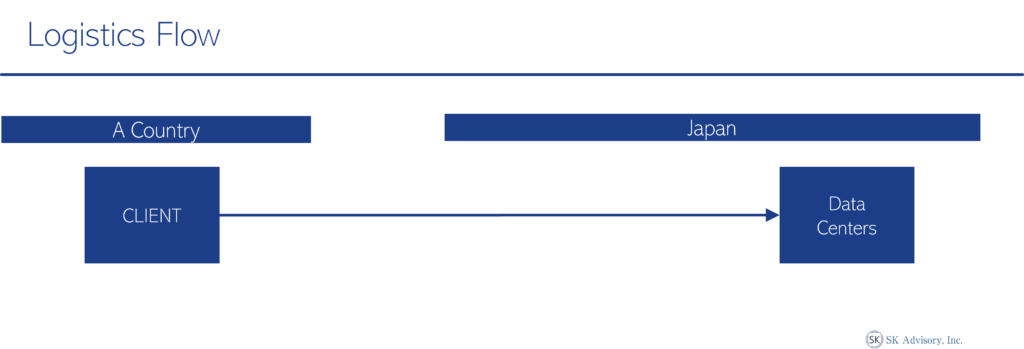
The increasing demand for importing and delivering goods to data centers in Japan is largely driven by the tech and AI boom. Often, clients who are non-resident companies seek to deliver goods—either their own or their end-clients’—to these data centers without making a sale. To facilitate this, the clients need to handle the import process into Japan on their own.

However, there’s a challenge: Japanese Customs generally mandates that only resident entities can act as importers. This is where the ACP – Attorney for Customs Procedures comes into play. It allows non-resident entities to act as the Importer of Record (IOR), bridging the gap in this process.

At ACP Japan, we possess a wealth of experience in supporting the import and delivery of goods to data centers. Typically, products shipped to these data centers are non-regulated items like servers, switches, transceivers, cables, and more. We’re here to assist you with your needs. Please feel free to contact us.  


Our ACP Service: The Best Solution for the Japan Importer of Record (IOR) and Exporter of Record (EOR)

ACP is an effective solution for addressing Importer of Record (IOR) and Exporter of Record (EOR) requirements in Japan. Through our ACP service, non-resident entities located outside Japan are able to import and export goods as Non-Resident IOR and EOR.

Below is an overview of our basic scope of work, together with a diagram illustrating the operational structure of the ACP service. Once ACP registration is completed, the non-resident entity can act as the Importer of Record (IOR) and Exporter of Record (EOR) in Japan.

Scope of Work – How We Can Assist

  • Consultation with Japan Customs to support successful ACP registration.
  • Liaison with relevant stakeholders, including freight forwarders and Japan Customs, to ensure the smooth and compliant import and export of goods.
  • Assistance in preparing and reviewing import and export clearance documentation.
  • Support in the calculation of customs value, in accordance with the Japan Customs Tariff Act.
  • Assistance with advance rulings on HS classification, customs valuation, and rules of origin.
  • Import compliance support for regulated products, including Domestic Administrator (sometimes referred to as “Domestic Representative”) Services under the Product Safety Acts (PSE/PSC) and food-related products regulated under the Food Sanitation Act.
  • Support for security export control, including list-based classification, catch-all control assessment, and assistance with export license applications to the Ministry of Economy, Trade and Industry (METI).
  • Record-keeping support in accordance with Article 95 of the Japan Customs Law.
  • Provision of professional trade and customs advisory services to address and resolve issues that may arise during import or export operations.

**Both import and export activities can benefit from the use of an ACP (Attorney for Customs Procedures). This support is applicable in scenarios where a non-resident acts as the Importer of Record (IOR) for imports and as the Exporter of Record (EOR) for exports.  

Three Steps to Initiate Shipments Under the ACP Program:

  1. Quotation Review to Contract Conclusion: Upon receiving your contact details, we will promptly provide a quotation for your review.
  2. Commencing the Registration of ACP (Attorney for Customs Procedures) to Japan Customs: This process is generally completed in about two weeks.
  3. Initiation of First Shipment, Import/Export


Track Record – Attorney for Customs Procedures (ACP) Services

We have supported import and export operations in Japan for over 200 clients across more than 40 countries.  

Examples of International Logistics Partners We Have Worked With

We have a proven track record of working with a wide range of logistics providers. As the Attorney for Customs Procedures (ACP), we handle customs-related responsibilities while logistics companies manage transportation and warehousing operations.

  • American Overseas Transport (AOT)
  • Apex International
  • Brink’s
  • CEVA Logistics
  • Coshipper
  • Crane Worldwide Logistics
  • DB Schenker
  • DGX (Dependable Global Express)
  • DHL Express
  • DHL Global Forwarding
  • Dimerco
  • DSV Air & Sea
  • Expeditors
  • FedEx Express
  • FERCAM
  • GOTO KAISOTEN Ltd.
  • Harumigumi
  • Herport
  • ICL Logistics
  • JAS Forwarding
  • Kintetsu Express
  • Kokusai Express

  • Kuehne + Nagel
  • Mitsubishi Logistics
  • MOL Logistics
  • Nankai Express
  • Nippon Express
  • OIA Global
  • PGS
  • Rhenus Group
  • Röhlig
  • Sankyu
  • Sanyo Logistics
  • Scan Global Logistics
  • Seino Schenker
  • SEKO Logistics
  • Shibusawa Logistics Corporation
  • Shin-Ei gumi
  • Shiproad
  • Sumitomo Warehouse
  • UPS
  • UPS Supply Chain Solutions
  • Yamato Transport

…and many other logistics providers in Japan and around the world.  

Japan Customs Reform | Clarification of Importer Definitions

We would like to inform you about a significant revision by Japan Customs, which clarifies the definition of an Importer. This change took effect on October 1, 2023.

With the revision, there has been an increase in cases where foreign corporations must use an Attorney for Customs Procedures (ACP) to become an Importer of Record (IOR) themselves. It is no longer feasible to nominate another entity merely in name as the importer.

In instances other than normal import transactions between an overseas seller and a Japanese buyer, where the importer does not have the authority to dispose of the goods after importation (for example, when a foreign corporation does not become the IOR themselves and nominates a forwarder, customs broker, or another third party who is not involved in the transaction to be the nominal IOR), there is a high probability that approval will not be granted as such nominations are not recognized as legitimate importers, therefore careful attention is required.

As a professional ACP firm, we follow the law to facilitate proper import procedures. You can entrust us with your importation needs with confidence. We look forward to discussing further with you.  

Japan Customs’ Official Guideline for E-Commerce Sellers

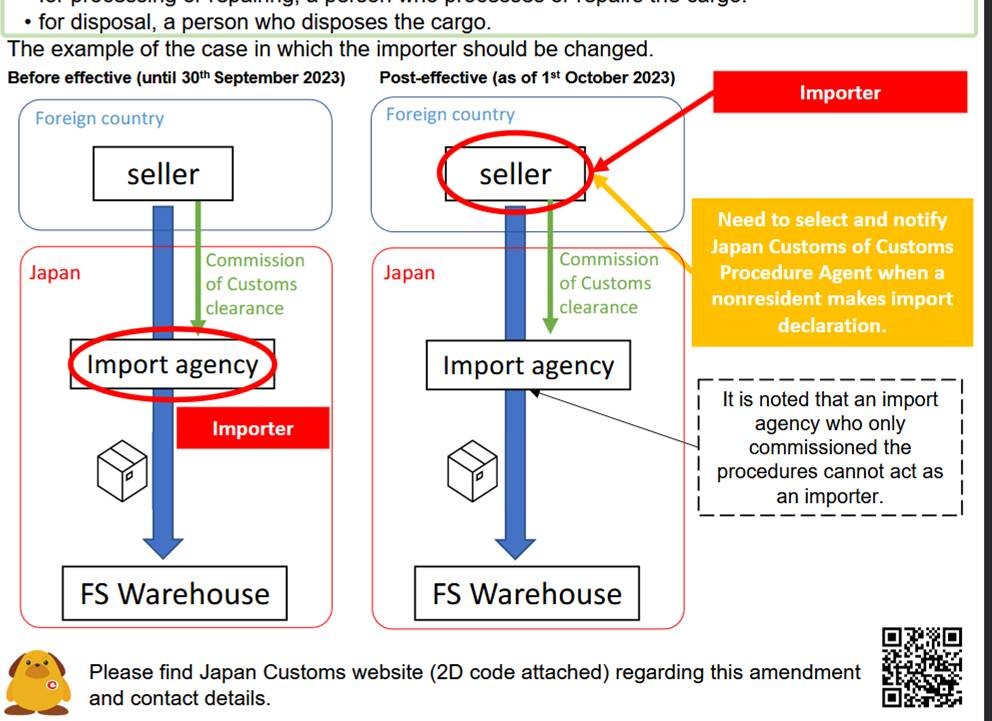
Here is the official guideline from Japan Customs. On page 2 of the leaflet, you’ll see a clear comparison:

  • On the left side, which reflects the rule before September 30, 2023, it was allowed for an “Import Agency” (such as a logistics or warehouse company) to act as the Importer of Record (IOR).
  • On the right side, from October 2023 onward, the Seller must be the IOR by appointing a Customs Procedures Agent — which is what we refer to as an ACP (Attorney for Customs Procedures).

Revisions Effective October 1, 2023:

Definition of the Importer
  • Regarding a cargo imported under an import transaction, an importer is equivalent to “a person who imports a cargo” defined in Article 6-1 (1), General Notification of the Customs Act. ….. This means, the Consignee, etc., in the case of imports conducted through normal transactions between an overseas seller and a Japanese buyer
  • In the cases other than above, an importer is a Person Having the Right of Disposal of the import cargo at the time of import declaration. If there is another person who acts on the purpose of the import*, that person is also included:

 In case of a cargo imported:
     – under lease contracts, a person who rents and uses the cargo.
     – for consignment sales, a person who sells the cargo in the name of himself/herself (consignee) by accepting the commission.
     – for processing or repairing, a person who processes or repairs the cargo.
     – for disposal, a person who disposes the cargo.


Case Study: Directives to use ACP

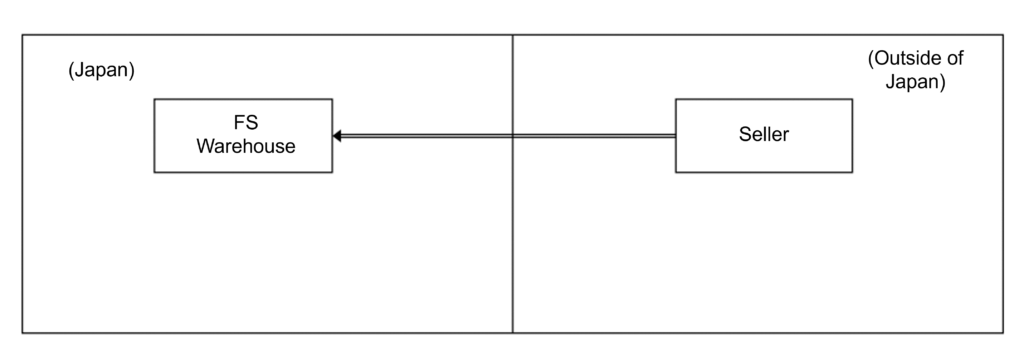
Case 1: Importing Goods Using FS (Fulfillment Services) by Non-resident Sellers

A non-resident seller plans to import goods for sale domestically using FS provided by EC platform operators. At the time of import declaration, there is no sales contract between the seller and the consumer. The seller (non-resident) is the main entity for sales on the EC platform after domestic pickup of the goods. Therefore, the seller, who aims to sell the goods in accordance with the purpose of import, needs to become the import declarant and appoint Attorney for Customs Procedure (ACP) to carry out the import declaration.

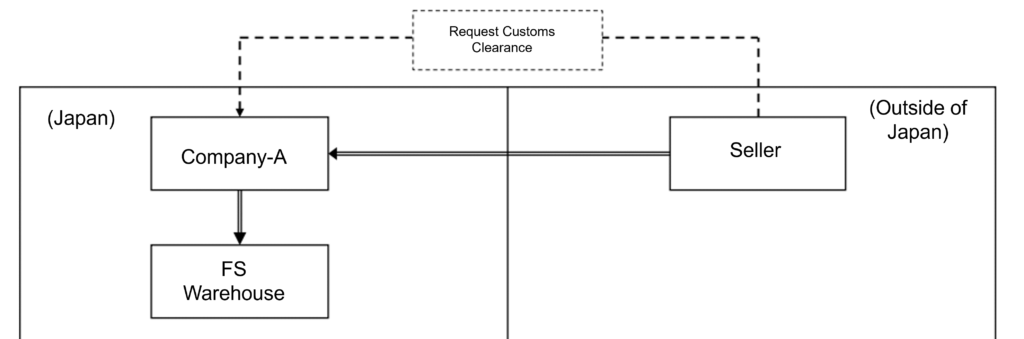
Case 2: Importing Goods Using FS by Non-resident Sellers

A non-resident seller plans to import goods for sale domestically using FS provided by EC platform operators. At the time of import declaration, there is no sales contract between the seller and the consumer. The seller (non-resident) entrusts domestic customs clearance arrangements to Company-A (located in Japan), but the main entity for selling the goods within the domestic market using FS remains the seller (non-resident). It is planned that the seller (non-resident), who intends to sell the goods on the EC platform after domestic pickup, should become the import declarant and appoints Attorney for Customs Procedure (ACP) in accordance with the purpose of import declaration.


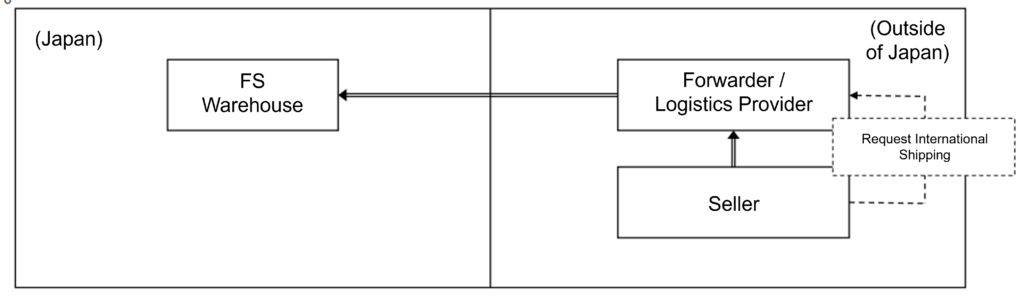
Case 3: Importing Goods Using FS by Non-resident Sellers

A non-resident seller plans to import goods for sale domestically using FS provided by EC platform operators. At the time of import declaration, there is no sales contract between the seller and the consumer. The seller (non-resident) entrusts the transportation of the goods from overseas sellers to Japan to an overseas forwarder, but the main entity for selling the goods within the domestic market using FS remains the seller (non-resident). It is planned that the seller (non-resident), who intends to sell the goods on the EC platform after domestic pickup, will become the import declarant and appoints Attorney for Customs Procedure (ACP) in accordance with the purpose of import declaration.

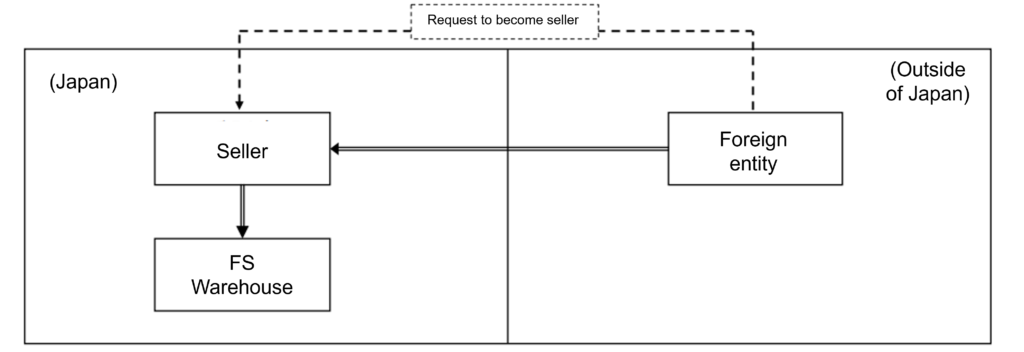
Case 4: Importing Goods for Consignment Sales

Goods (consignment sales goods) intended for domestic sale by an assignee who has received consignment sales from a non-resident consignor are imported. The imported goods are stored in an FS warehouse and sold on the EC platform under the name of the assignee. The assignee is the main entity for selling the goods within the domestic market using FS.

Either of the following options is necessary:

The consignor (non-resident) who has the authority to dispose of the consignment sales goods becomes the import declarant, appoints Attorney for Customs Procedure (ACP), and carries out the import declaration.

The assignee (i.e., the seller on the EC platform) who conducts the act of selling on behalf of themselves as the purpose of import becomes the import declarant and carries out the import declaration.

For more information regarding the revised regulations by the Japan Customs, please refer to the following:

(Link: Revision of Import Declaration Items and Attorney for Customs Procedure (ACP) System) Ministry of Finance, Japan Customs July 2023 With the expansion of cross-border e-commerce, the importation of goods for online shopping has increased, leading to a significant number of cases involving the smuggling of illegal drugs and counterfeit goods that infringe upon intellectual property rights. Particularly concerning are instances of tax evasion, where goods imported through fulfillment services (FS) are declared at unreasonably low prices to evade customs duties.

In light of these circumstances, we have conducted a review of the existing system to ensure the continued facilitation of smooth imports while effectively combating smuggling activities and ensuring proper taxation. Effective from October 1, (2023), there will be an addition to the import declaration items under the Customs Law Enforcement Order, requiring the inclusion of the “address and name of the person intending to import the goods” at the time of import declaration.

Furthermore, there will be additions to the declaration items for Attorney for Customs Procedure (ACP), including information regarding the relationship between the declarant and the Attorney for Customs Procedure (ACP). Additionally, it will be mandatory to submit the contractual documents between the declarant and the ACP. For specific details regarding the revisions to the system, please refer to the following reference materials.  

 Reference (Japan Customs)

Track Record – Attorney for Customs Procedures (ACP) Services

We have supported import and export operations in Japan for over 200 clients across more than 40 countries.

Examples of International Logistics Partners We Have Worked With

We have a proven track record of working with a wide range of logistics providers. As the Attorney for Customs Procedures (ACP), we handle customs-related responsibilities while logistics companies manage transportation and warehousing operations.

  • American Overseas Transport (AOT)
  • Apex International
  • Brink’s
  • CEVA Logistics
  • Coshipper
  • Crane Worldwide Logistics
  • DB Schenker
  • DGX (Dependable Global Express)
  • DHL Express
  • DHL Global Forwarding
  • Dimerco
  • DSV Air & Sea
  • Expeditors
  • FedEx Express
  • FERCAM
  • GOTO KAISOTEN Ltd.
  • Harumigumi
  • Herport
  • ICL Logistics
  • JAS Forwarding
  • Kintetsu Express
  • Kokusai Express
  • Kuehne + Nagel
  • Mitsubishi Logistics
  • MOL Logistics
  • Nankai Express
  • Nippon Express
  • OIA Global
  • PGS
  • Rhenus Group
  • Röhlig
  • Sankyu
  • Sanyo Logistics
  • Scan Global Logistics
  • Seino Schenker
  • SEKO Logistics
  • Shibusawa Logistics Corporation
  • Shin-Ei gumi
  • Shiproad
  • Sumitomo Warehouse
  • UPS
  • UPS Supply Chain Solutions
  • Yamato Transport

…and many other logistics providers in Japan and around the world.

 

Taxes on Imports: Customs Duty and Japan Consumption Tax (JCT)

At the time of import, Import Duty and Japan Consumption Tax (JCT) are imposed:

▶ Customs Duty:

Calculated by applying the tariff rate to the declared customs value (Tariff rate varies by HS code). Check tariff rates at Japan Customs Duty Tariff Rates: JP Tariff Rates. The importer is responsible for paying the tariff on the declared value.

▶ Japan Consumption Tax (JCT):

JCT is set at a fixed rate of 10%. JCT is calculated as 10% of the total import declaration value plus customs duty. 

Tax Filing and Payment to the Tax Office

After importing goods, you are allowed to collect 10% Japan Consumption Tax (JCT) from customers upon domestic sales. If you are a JCT-exempt entity, no further action is required.
If you are a JCT-taxable entity, you must file a JCT tax return with the tax office and pay the collected sales JCT. During this process, you may deduct or claim a refund of the JCT paid at the time of import.

Only the Importer of Record Can Claim Input Tax Credit

The right to claim an input tax credit for import JCT belongs exclusively to the Importer of Record (IOR). This is why appointing an Attorney for Customs Procedures (ACP) is critical. If the foreign company does not act as the importer—such as when a third party is listed as the IOR—the company may lose the right to reclaim the import JCT, resulting in a significant financial loss.

Compliance with the Japanese Invoice System

Since October 2023, Japan has implemented a new JCT Invoice System, similar to the European VAT compliance framework. Foreign sellers must consider whether to register as a Qualified Invoice Issuer, particularly when selling to JCT-registered buyers in Japan. If a foreign seller is not registered as a Qualified Invoice Issuer, the buyer may be unable to fully claim input JCT through their JCT tax return.

To maintain good business relationships, it is often advisable to register proactively. However, once registered as a Qualified Invoice Issuer, you can no longer be treated as a tax-exempt entity and must begin filing and paying JCT accordingly.

Necessary to Appoint a Tax Representative

To complete this process—registration and JCT filing—a Tax Representative (usually a certified Japanese tax accountant) must be appointed separately from the ACP.
We work closely with trusted tax professionals to provide comprehensive, one-stop support for both ACP and JCT Tax Representative services.

Our Japan Consumption Tax (JCT) Representative Services

At ACP Japan, we provide a comprehensive one-stop service that covers both customs procedures through the Attorney for Customs Procedures (ACP) and Japan Consumption Tax (JCT) procedures with the National Tax Agency through a designated JCT Tax Representative.

By working closely with our trusted partner tax accountants, we act as your ACP while maintaining close coordination and information sharing with the tax representative. This collaboration ensures the proper deduction and refund of Japan Consumption Tax paid at the time of importation.


Our ACP Service: The Best Solution for the Japan Importer of Record (IOR) and Exporter of Record (EOR)

ACP is an effective solution for addressing Importer of Record (IOR) and Exporter of Record (EOR) requirements in Japan. Through our ACP service, non-resident entities located outside Japan are able to import and export goods as Non-Resident IOR and EOR.

Below is an overview of our basic scope of work, together with a diagram illustrating the operational structure of the ACP service. Once ACP registration is completed, the non-resident entity can act as the Importer of Record (IOR) and Exporter of Record (EOR) in Japan.

Scope of Work – How We Can Assist

  • Consultation with Japan Customs to support successful ACP registration.
  • Liaison with relevant stakeholders, including freight forwarders and Japan Customs, to ensure the smooth and compliant import and export of goods.
  • Assistance in preparing and reviewing import and export clearance documentation.
  • Support in the calculation of customs value, in accordance with the Japan Customs Tariff Act.
  • Assistance with advance rulings on HS classification, customs valuation, and rules of origin.
  • Import compliance support for regulated products, including Domestic Administrator (sometimes referred to as “Domestic Representative”) Services under the Product Safety Acts (PSE/PSC) and food-related products regulated under the Food Sanitation Act.
  • Support for security export control, including list-based classification, catch-all control assessment, and assistance with export license applications to the Ministry of Economy, Trade and Industry (METI).
  • Record-keeping support in accordance with Article 95 of the Japan Customs Law.
  • Provision of professional trade and customs advisory services to address and resolve issues that may arise during import or export operations.

**Both import and export activities can benefit from the use of an ACP (Attorney for Customs Procedures). This support is applicable in scenarios where a non-resident acts as the Importer of Record (IOR) for imports and as the Exporter of Record (EOR) for exports.

Three Steps to Initiate Shipments Under the ACP Program:

  1. Quotation Review to Contract Conclusion: Upon receiving your contact details, we will promptly provide a quotation for your review.
  2. Commencing the Registration of ACP (Attorney for Customs Procedures) to Japan Customs: This process is generally completed in about two weeks.
  3. Initiation of First Shipment, Import/Export

Why choose us?

We specialize in navigating complex issues at the intersection of customs procedures and taxation—an area where our ability to offer practical, comprehensive support from both perspectives sets us apart. Understanding the close relationship between customs duties and national taxes (especially, Japan Consumption Tax – JCT), and addressing both in an integrated manner, is crucial in the context of international trade.

  • Customs and International Trade Professionals – Led by our CEO, Mr. Sawada—Certified Customs Specialist and former KPMG professional—SK Advisory provides expert-level support in Customs and international trade.
  • Full Compliance with Japanese Customs Law – We ensure full adherence to Japanese Customs Law, including Importer of Record (IOR) structure, HS code classification, and customs valuation. We assist in preparing all essential shipping documents for non-resident entities.
  • One-Stop Support for ACP and JCT Tax Representative Services – In collaboration with trusted partner tax accountants, we provide comprehensive support for both customs procedures through the Attorney for Customs Procedures (ACP) and Japan Consumption Tax (JCT) filings through the JCT Tax Representative.
  • Multilingual Communication – Our team communicates fluently in English, Japanese, and Chinese, offering smooth coordination with global clients and authorities in Japan.
  • Support for Regulated Products – Our ACP/IOR partnership system can manage regulated items, including cosmetics, PSE-products, foodstuffs, and tableware.
  • Trusted by Global Clients – Serving around 100 ACP clients annually, including many Amazon sellers, we’re a certified provider on Amazon SPN (Service Provider Network) under Trade Compliance.

Track Record – Attorney for Customs Procedures (ACP) Services

We have supported import and export operations in Japan for over 200 clients across more than 40 countries.


Examples of International Logistics Partners We Have Worked With

We have a proven track record of working with a wide range of logistics providers. As the Attorney for Customs Procedures (ACP), we handle customs-related responsibilities while logistics companies manage transportation and warehousing operations.

  • American Overseas Transport (AOT)
  • Apex International
  • Brink’s
  • CEVA Logistics
  • Coshipper
  • Crane Worldwide Logistics
  • DB Schenker
  • DGX (Dependable Global Express)
  • DHL Express
  • DHL Global Forwarding
  • Dimerco
  • DSV Air & Sea
  • Expeditors
  • FedEx Express
  • FERCAM
  • GOTO KAISOTEN Ltd.
  • Harumigumi
  • Herport
  • ICL Logistics
  • JAS Forwarding
  • Kintetsu Express
  • Kokusai Express
  • Kuehne + Nagel
  • Mitsubishi Logistics
  • MOL Logistics
  • Nankai Express
  • Nippon Express
  • OIA Global
  • PGS
  • Rhenus Group
  • Röhlig
  • Sankyu
  • Sanyo Logistics
  • Scan Global Logistics
  • Seino Schenker
  • SEKO Logistics
  • Shibusawa Logistics Corporation
  • Shin-Ei gumi
  • Shiproad
  • Sumitomo Warehouse
  • UPS
  • UPS Supply Chain Solutions
  • Yamato Transport

…and many other logistics providers in Japan and around the world.

 

Import Permit Document and Alert on IOR Service

The Import Permit Document holds significant importance in import clearance procedures. It serves as evidence for the deduction of Japan Consumption Tax (JCT). When filing periodic JCT returns, this document is necessary to claim deductions or refunds for the amount paid during import. It is crucial to ensure that the Import Permit accurately reflects the information of the Importer of Record (IOR) as it directly impacts the eligibility for JCT deduction.

Non-resident entities utilizing the services of an Attorney for Customs Procedures (ACP) will have their names clearly stated on the Import Permit as IOR, allowing them to successfully claim JCT deductions.

Import Permit Document Sample

Upon completion of import clearance procedures, Japan Customs issues an Import Permit document. 

Please refer to the sample Import Permit document below:


Japan Consumption Tax (JCT) is set at a fixed rate of 10%. On the other hand, the tariff rate for Customs Duty varies depending on the HS Code assigned to the imported goods. To verify the applicable tariff rate, you can refer to the Japan Customs Tariff Schedule on their official website here:  Japan Customs Tariff Schedule


Alert: Importer (IOR) Service Provider May Not Be in Compliance with Customs Laws

Attention must be given to cases where IOR service providers or forwarders act as the IOR but mask or omit their information on the Import Permit Document. This raises concerns about their compliance with Japan Customs Law, such as Customs Valuation. It is important to be cautious when encountering such situations as they may indicate underlying issues.

Importers are responsible for paying penalties, such as additional taxes or penalties, when there is a shortfall in the tax amount owed. It is the importer’s obligation to fulfill their tax payment requirements. However, it should be noted that IOR service providers may not be cooperative in the event of a customs post clearance audit.

Unfortunately, we actually observe that some non-resident entities suffer from the fact that the 10% import consumption tax is not deductible (or refundable), and they were penalized by the customs post clearance audit. In the end, they decided to use ACP, not IOR service provider.

While not all IOR service providers are non-compliant, it is observed that certain providers engage in inappropriate practices. Opting for these providers based on cost-saving measures may result in the inability to deduct or refund 10% JCT, leading to hidden costs and detrimental business outcomes.

As a reputable Customs professional, ACP Japan strictly adheres to Japan Customs Law and confidently provides clients with the Import Permit Document. We are listed as the ACP, while clients are appropriately identified as the IOR on the document.  

Benefits of Using ACP

For non-resident entities, choosing ACP is strongly recommended. We ensure full compliance with the Japan Customs Law and offer the best solution for correct JCT deduction/refund.


Japanese Customs System Reform: Clarification of Importer Definitions

Starting October 1, 2023, Japanese Customs has instituted a pivotal reform aimed at addressing the issue of foreign sellers improperly designating third parties (such as forwarders or customs agents) as importers.

This revision necessitates foreign corporations to utilize an Attorney for Customs Procedures (ACP) to assume the role of Importer of Record (IOR) directly in many cases. The practice of merely nominally appointing another entity as the importer is no longer feasible.

Notably, foreign corporations that act as importers themselves, through the engagement of ACP, are eligible for Japan Consumption Tax (JCT) benefits. 

As a dedicated ACP firm, we ensure compliance with the law to facilitate correct import procedures, allowing you to trust us with your importation requirements confidently. We are eager to engage in further discussions with you.

Why choose us?

We specialize in navigating complex issues at the intersection of customs procedures and taxation—an area where our ability to offer practical, comprehensive support from both perspectives sets us apart. Understanding the close relationship between customs duties and national taxes (especially, Japan Consumption Tax – JCT), and addressing both in an integrated manner, is crucial in the context of international trade.

  • Customs and International Trade Professionals – Led by our CEO, Mr. Sawada—Certified Customs Specialist and former KPMG professional—ACP Japan provides expert-level support in Customs and international trade.
  • Full Compliance with Japanese Customs Law – We ensure full adherence to Japanese Customs Law, including Importer of Record (IOR) structure, HS code classification, and customs valuation. We assist in preparing all essential shipping documents for non-resident entities.
  • One-Stop Support for ACP and JCT Tax Representative Services – In collaboration with trusted partner tax accountants, we provide comprehensive support for both customs procedures through the Attorney for Customs Procedures (ACP) and Japan Consumption Tax (JCT) filings through the JCT Tax Representative.
  • Multilingual Communication – Our team communicates fluently in English, Japanese, and Chinese, offering smooth coordination with global clients and authorities in Japan.
  • Support for Regulated Products – Our ACP/IOR partnership system can manage regulated items, including cosmetics, PSE-products, foodstuffs, and tableware.
  • Trusted by Global Clients – Serving around 100 ACP clients annually, including many Amazon sellers, we’re a certified provider on Amazon SPN (Service Provider Network) under Trade Compliance.

Track Record – Attorney for Customs Procedures (ACP) Services

We have supported import and export operations in Japan for over 200 clients across more than 40 countries.

Examples of International Logistics Partners We Have Worked With

We have a proven track record of working with a wide range of logistics providers. As the Attorney for Customs Procedures (ACP), we handle customs-related responsibilities while logistics companies manage transportation and warehousing operations.

  • American Overseas Transport (AOT)
  • Apex International
  • Brink’s
  • CEVA Logistics
  • Coshipper
  • Crane Worldwide Logistics
  • DB Schenker
  • DGX (Dependable Global Express)
  • DHL Express
  • DHL Global Forwarding
  • Dimerco
  • DSV Air & Sea
  • Expeditors
  • FedEx Express
  • FERCAM
  • GOTO KAISOTEN Ltd.
  • Harumigumi
  • Herport
  • ICL Logistics
  • JAS Forwarding
  • Kintetsu Express
  • Kokusai Express
  • Kuehne + Nagel
  • Mitsubishi Logistics
  • MOL Logistics
  • Nankai Express
  • Nippon Express
  • OIA Global
  • PGS
  • Rhenus Group
  • Röhlig
  • Sankyu
  • Sanyo Logistics
  • Scan Global Logistics
  • Seino Schenker
  • SEKO Logistics
  • Shibusawa Logistics Corporation
  • Shin-Ei gumi
  • Shiproad
  • Sumitomo Warehouse
  • UPS
  • UPS Supply Chain Solutions
  • Yamato Transport

…and many other logistics providers in Japan and around the world.
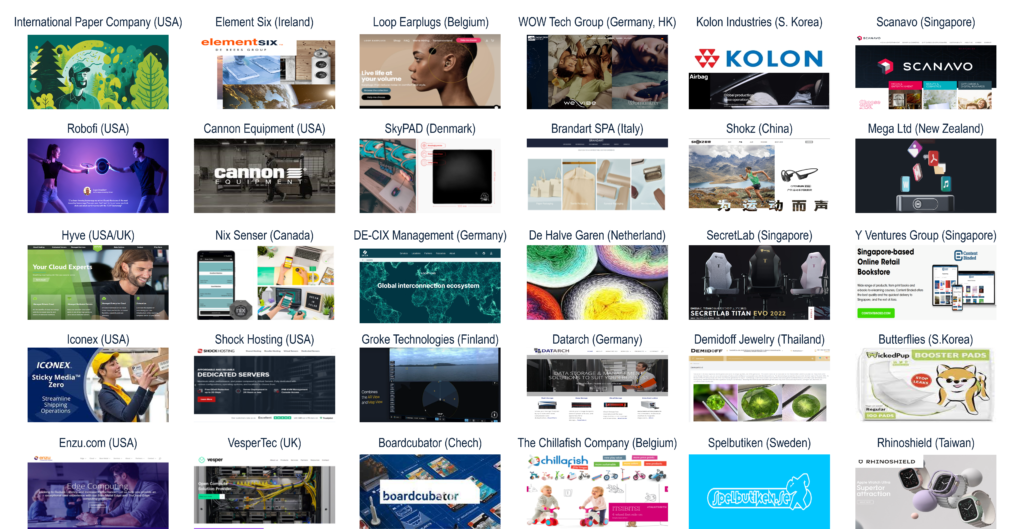
 

Our ACP Service: The Best Solution for the Japan Importer of Record (IOR) and Exporter of Record (EOR)

ACP is an effective solution for addressing Importer of Record (IOR) and Exporter of Record (EOR) requirements in Japan. Through our ACP service, non-resident entities located outside Japan are able to import and export goods as Non-Resident IOR and EOR.

Below is an overview of our basic scope of work, together with a diagram illustrating the operational structure of the ACP service. Once ACP registration is completed, the non-resident entity can act as the Importer of Record (IOR) and Exporter of Record (EOR) in Japan.

Scope of Work – How We Can Assist

  • Consultation with Japan Customs to support successful ACP registration.
  • Liaison with relevant stakeholders, including freight forwarders and Japan Customs, to ensure the smooth and compliant import and export of goods.
  • Assistance in preparing and reviewing import and export clearance documentation.
  • Support in the calculation of customs value, in accordance with the Japan Customs Tariff Act.
  • Assistance with advance rulings on HS classification, customs valuation, and rules of origin.
  • Import compliance support for regulated products, including Domestic Administrator (sometimes referred to as “Domestic Representative”) Services under the Product Safety Acts (PSE/PSC) and food-related products regulated under the Food Sanitation Act.
  • Support for security export control, including list-based classification, catch-all control assessment, and assistance with export license applications to the Ministry of Economy, Trade and Industry (METI).
  • Record-keeping support in accordance with Article 95 of the Japan Customs Law.
  • Provision of professional trade and customs advisory services to address and resolve issues that may arise during import or export operations.

**Both import and export activities can benefit from the use of an ACP (Attorney for Customs Procedures). This support is applicable in scenarios where a non-resident acts as the Importer of Record (IOR) for imports and as the Exporter of Record (EOR) for exports.

Three Steps to Initiate Shipments Under the ACP Program:

  1. Quotation Review to Contract Conclusion: Upon receiving your contact details, we will promptly provide a quotation for your review.
  2. Commencing the Registration of ACP (Attorney for Customs Procedures) to Japan Customs: This process is generally completed in about two weeks.
  3. Initiation of First Shipment, Import/Export


Japan Qualified Invoice System and import JCT (Japan Consumption Tax)

Japan Qualified Invoice System and Compliance JCT (Japan Consumption Tax)

Recently, many companies have been registering as Qualified Invoice Issuers for Japanese Consumption Tax (JCT) due to the new invoice system introduced in October 2023. This new system is similar to the EU’s VAT invoice system.

After October 2023, your Japanese customer cannot claim input JCT credits unless the sellers (suppliers) issue a qualified invoice that includes a JCT registration number. To issue a qualified invoice, sellers (suppliers) need to be a taxable entity and obtain a JCT registration number.

Before October 2023:

Any customer (Company-B) who paid for goods or services could deduct input JCT regardless of whether the seller (Company-A) was registered for JCT. There was no requirement to verify the tax status of the seller.

After October 2023:

Any customer (Company-B) can only deduct input JCT if Company-A, the seller, is registered and can provide a qualified invoice with a JCT registration number. If Company-A cannot issue such an invoice, Company-B may choose not to continue purchases from them. If Company-A sells only to consumers and not businesses, it may not need to issue qualified invoices since consumers typically do not claim JCT tax returns. 


Once Company-A obtains a JCT invoice registration number, it becomes a taxable entity required to file JCT returns regularly.

For non-resident entities (Company-A) importing and selling in Japan, the standard procedure involves three steps:

  1. Pay import JCT to customs: 10% of the import customs value.
  2. Collect JCT from customers in Japan: 10% of the sales price.
  3. File a JCT tax return and pay the net JCT to the tax office.

If Company-A paid the import JCT as the importer using an Attorney for Customs Procedures (ACP), they need only pay the net amount of sales JCT minus import JCT.

If Company-A paid the import JCT but was not the importer, they must pay all the collected sales JCT without deducting the import JCT.

Therefore, using an ACP to act as the Importer of Record (IOR) is crucial for managing JCT deductions and refunds. If another company acts as the IOR, you cannot deduct the import JCT, resulting in significant costs.

We strongly recommend using our ACP services to ensure you can act as the IOR, optimizing your JCT handling. Our team has extensive experience helping clients become importers and successfully manage their JCT responsibilities. You can rely on our expertise to navigate these complexities.


Our ACP Service: The Best Solution for the Japan Importer of Record (IOR) and Exporter of Record (EOR)

ACP is an effective solution for addressing Importer of Record (IOR) and Exporter of Record (EOR) requirements in Japan. Through our ACP service, non-resident entities located outside Japan are able to import and export goods as Non-Resident IOR and EOR.

Below is an overview of our basic scope of work, together with a diagram illustrating the operational structure of the ACP service. Once ACP registration is completed, the non-resident entity can act as the Importer of Record (IOR) and Exporter of Record (EOR) in Japan.

Scope of Work – How We Can Assist

  • Consultation with Japan Customs to support successful ACP registration.
  • Liaison with relevant stakeholders, including freight forwarders and Japan Customs, to ensure the smooth and compliant import and export of goods.
  • Assistance in preparing and reviewing import and export clearance documentation.
  • Support in the calculation of customs value, in accordance with the Japan Customs Tariff Act.
  • Assistance with advance rulings on HS classification, customs valuation, and rules of origin.
  • Import compliance support for regulated products, including Domestic Administrator (sometimes referred to as “Domestic Representative”) Services under the Product Safety Acts (PSE/PSC) and food-related products regulated under the Food Sanitation Act.
  • Support for security export control, including list-based classification, catch-all control assessment, and assistance with export license applications to the Ministry of Economy, Trade and Industry (METI).
  • Record-keeping support in accordance with Article 95 of the Japan Customs Law.
  • Provision of professional trade and customs advisory services to address and resolve issues that may arise during import or export operations.

**Both import and export activities can benefit from the use of an ACP (Attorney for Customs Procedures). This support is applicable in scenarios where a non-resident acts as the Importer of Record (IOR) for imports and as the Exporter of Record (EOR) for exports.  

Three Steps to Initiate Shipments Under the ACP Program:

  1. Quotation Review to Contract Conclusion: Upon receiving your contact details, we will promptly provide a quotation for your review.
  2. Commencing the Registration of ACP (Attorney for Customs Procedures) to Japan Customs: This process is generally completed in about two weeks.
  3. Initiation of First Shipment, Import/Export


Our Japan Consumption Tax (JCT) Representative Services

At ACP Japan, we provide a comprehensive one-stop service that covers both customs procedures through the Attorney for Customs Procedures (ACP) and Japan Consumption Tax (JCT) procedures with the National Tax Agency through a designated JCT Tax Representative.

By working closely with our trusted partner tax accountants, we act as your ACP while maintaining close coordination and information sharing with the tax representative. This collaboration ensures the proper deduction and refund of Japan Consumption Tax paid at the time of importation.  


Track Record – Attorney for Customs Procedures (ACP) Services

We have supported import and export operations in Japan for over 200 clients across more than 40 countries.  

Examples of International Logistics Partners We Have Worked With

We have a proven track record of working with a wide range of logistics providers. As the Attorney for Customs Procedures (ACP), we handle customs-related responsibilities while logistics companies manage transportation and warehousing operations.

  • Apex International
  • Brink’s
  • CEVA Logistics
  • Coshipper
  • Crane Worldwide Logistics
  • DB Schenker
  • DGX (Dependable Global Express)
  • DHL Express
  • DHL Global Forwarding
  • Dimerco
  • DSV Air & Sea
  • Expeditors
  • FedEx Express
  • FERCAM
  • GOTO KAISOTEN Ltd.
  • Harumigumi
  • Herport
  • ICL Logistics
  • JAS Forwarding
  • Kintetsu Express
  • Kokusai Express
  • Kuehne + Nagel
  • Mitsubishi Logistics
  • MOL Logistics
  • Nankai Express
  • Nippon Express
  • OIA Global
  • PGS
  • Rhenus Group
  • Röhlig
  • Sankyu
  • Sanyo Logistics
  • Scan Global Logistics
  • Seino Schenker
  • SEKO Logistics
  • Shin-Ei gumi
  • Shiproad
  • Sumitomo Warehouse
  • UPS
  • UPS Supply Chain Solutions
  • Yamato Transport

…and many other logistics providers in Japan and around the world.