All posts by ACP JAPAN

Japan’s New E-Commerce Platform Taxation Regime (FY2026 Japanese Tax Reform Outline)

Japan Consumption Tax Reform on Cross-Border E-Commerce

In December 2025, the Japanese ruling parties released the FY2026 Tax Reform Outline.
The outline includes significant reforms to Japan Consumption Tax (JCT) aimed at ensuring proper taxation of cross-border e-commerce (CBEC) involving the sale of goods.

Key Changes

1. Shift of JCT Filing and Payment Obligation to Large Platform Operators from Individual Sellers

For sales of goods conducted through online platforms, platform operators with total intermediary sales exceeding JPY 5 billion will become liable for filing and paying JCT on behalf of the sellers.

2. Review of the Small-Value Import Tax Exemption

For cross-border mail-order sales, goods priced at JPY 10,000 or less (excluding tax) will also become subject to JCT, although previously they were JCT exempted. Under the new rules, the seller will bear the JCT filing obligation.

Effective date: On or after April 1, 2028


1. Introduction of Platform Taxation for the Sale of Goods

The Japanese government has long regarded it as a major issue that consumption tax collected by foreign sellers (non-residents) through large e-commerce platforms such as Amazon is often not properly reported or paid.

According to the Government, it has been suggested that uncollected JCT related to fulfillment-based sales by foreign sellers in Japan may amount to approximately JPY 500 billion to JPY 1 trillion annually. (source: Government Tax Commission – Expert Panel, June 11, 2025)

To address this issue, Japan plans to shift the JCT payment obligation from individual foreign sellers to large-scale platform operators, requiring platforms to collect and remit JCT in aggregate.

Possible import JCT refund scenarios under the new platform taxation regime

Under the current system, when a foreign seller files JCT returns in Japan, import JCT paid at the time of importation can only be claimed as an input tax credit if the foreign seller itself acts as the Importer of Record (IOR).
This requires appointing an Attorney for Customs Procedures (ACP) and retaining the import permit issued by Japan Customs.

Under the new platform taxation framework, platform operators such as Amazon are expected to remit JCT on behalf of foreign sellers.
At the same time, import JCT paid by foreign sellers is expected to be creditable at the platform level, based on the tax reform outline.

While detailed regulations are yet to be finalized, the outline suggests the following structure:

Foreign sellers will continue to pay import JCT to Japan Customs at the time of importation.

Platform operators applying input tax credits will likely refund the corresponding import JCT amount to the foreign sellers.

However, input tax credits at the platform level will only be allowed for goods imported under the name of the foreign seller as the IOR.
Accordingly, platforms are expected to require import permits clearly showing the foreign seller as the importer.

As a result, if goods are imported under the name of a third party (e.g., a warehouse, or any IOR service provider), the platform may not be able to apply the input tax credit, and the foreign seller may not receive reimbursement of the import JCT.

Practical Implications for Foreign Sellers

For foreign sellers, it is therefore critically important to establish an import structure in which they act as the Importer of Record (IOR) by appointing an Attorney for Customs Procedures (ACP).

In preparation for the new system, we strongly recommend reviewing and restructuring import operations at an early stage to ensure compliance.

Notably, following the October 2023 revision of the Japan Customs Act, foreign sellers selling through e-commerce platforms such as Amazon have already been required to act as importers themselves through the use of an ACP.
From this perspective, the 2023 customs reform and the upcoming consumption tax reform are aligned in policy intent.

As specialists in ACP services, we have supported more than 200 foreign companies in establishing compliant import structures in Japan.
We are happy to assist you in building an import framework that enables proper treatment of import JCT and future tax adjustments with e-commerce platforms.


2. Review of the Small-Value Import Tax Exemption

Previously, when Japanese consumers ordered goods that were shipped directly from overseas sellers without using fulfillment services, imports with a taxable value of JPY 10,000 or less were exempt from consumption tax.

However, this exemption has been criticized for creating competitive distortions compared to domestic businesses that bear consumption tax on their procurement costs.

To address this issue, Japan plans to abolish the exemption for small-value goods, making sales of goods priced at JPY 10,000 or less (so-called “specified low-value assets”) subject to JCT, with the seller responsible for tax payment.


3. Outlook and Next Steps

At this stage, the reforms are based on the FY2026 Tax Reform Outline, and detailed legislation and operational rules will be finalized following Diet deliberations.

We will continue to monitor legislative developments closely and provide timely updates as further details become available.

If you have any questions regarding ACP services, Importer of Record structures, or the impact of the new platform taxation rules, please feel free to contact us.

Domestic Administrator Services for Japanese Product Safety Acts (PSE / PSC)

Effective December 25, 2025, amendments to Japan’s Four Product Safety Acts, including PSE and PSC, came into force, introducing new regulatory obligations for foreign businesses selling products directly to consumers in Japan. Foreign entities selling PS Mark-regulated products directly to Japanese consumers are now required to comply with technical standards, submit notifications to METI, and appoint a Domestic Administrator (sometimes referred to as “Domestic Representative”) in Japan.  

1. Overview of the New Regulations

1-1. Regulations on Overseas Sellers

With the growth of cross-border e-commerce, an increasing number of foreign sellers have been offering Four Product Safety Acts regulated products (e.g., PSE, PSC products) directly to Japanese consumers. Under the previous legal framework, however, the entity responsible for product safety was often unclear.

Under the amended law, foreign sellers who supply regulated products directly to consumers in Japan via online marketplaces or similar platforms are defined as “Specified Importers” if they conduct business involving the import of designated products. Specified Importers must comply with obligations equivalent to those imposed on domestic manufacturers and importers, including:

  • Filing notifications with authorities

  • Ensuring products comply with technical safety standards

To ensure enforceability, Specified Importers are also required to appoint a Domestic Administrator (sometimes referred to as “Domestic Representative”) in Japan.

Requirements for a Domestic Representative include:

  • Having a registered address in Japan

  • Ability to communicate in Japanese

  • Entering into a written delegation agreement covering prescribed responsibilities


Regulated Product Categories

ACTS Example Products
PSE (Electrical Appliances and Materials Safety Act) Electrical devices, mobile batteries
PSC (Consumer Product Safety Act) Infant toys, baby beds, laser pointers
PSTG (Gas Business Act) Gas appliances for city gas
PSLPG (LPG Act) LPG canisters and LPG-powered equipment


1-2. New Safety Requirements for Children’s Products

Unlike the U.S. and EU, Japan historically lacked comprehensive mandatory safety standards for children’s products, allowing certain items to be sold without adequate safety verification.

The amendment introduces a new regulatory category: “Specified Products for Children.”
Two product categories have been designated:

  • Baby beds

  • Toys intended for children under three years old

From December 25, 2025 onward:

  • Products must comply with technical safety standards, and

  • Display required labeling (age indication, safety warnings, usage instructions)

Products meeting applicable requirements may display the Child PSC Mark and be legally sold.


2. Appointment of a Domestic Administrator

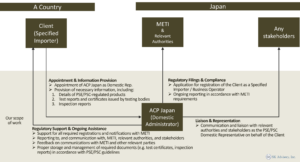
Foreign entities classified as Specified Importers must appoint a Domestic Representative and file notification with METI.

ACP JAPAN provides a combined solution, offering:

  • ACP (Attorney for Customs Procedures) Service

  • Domestic Administrator (Representative) Service under the Four Product Safety Acts

This enables foreign sellers to comply with regulatory requirements while importing and selling legally in Japan.


PSE and PSC Domestic Administrator Service


Reference

Ministry of Economy, Trade and Industry (METI) –
“From December 25, 2025, foreign businesses will also be required to submit notifications.”


Track Record – Attorney for Customs Procedures (ACP) Services

We have supported import and export operations in Japan for over 200 clients across more than 40 countries.  

What is ACP? – Attorney for Customs Procedure

In principle, Japan Customs does not permit a foreign entity to act as the Importer of Record (*IOR). But the foreign entity can act as a non-resident importer (IOR – Importer of Record) if you appoint an ACP (Attorney for Customs Procedure) who can handle the customs procedure on your behalf.

We, ACP Japan provide this service as being ACP. On behalf of non-resident clients, we support by ensuring the import customs procedure. We support many import projects including E-commerce such as Amazon’s FBA (Fulfillment By Amazon) program and Rakuten for the international sellers.

Please feel free to contact us!

Our ACP Service: The Best Solution for the Japan Importer of Record (IOR) and Exporter of Record (EOR)

ACP is an effective solution for addressing Importer of Record (IOR) and Exporter of Record (EOR) requirements in Japan. Through our ACP service, non-resident entities located outside Japan are able to import and export goods as Non-Resident IOR and EOR.

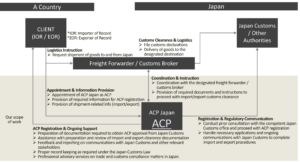
Below is an overview of our basic scope of work, together with a diagram illustrating the operational structure of the ACP service. Once ACP registration is completed, the non-resident entity can act as the Importer of Record (IOR) and Exporter of Record (EOR) in Japan.

Scope of Work – How We Can Assist

  • Consultation with Japan Customs to support successful ACP registration.
  • Liaison with relevant stakeholders, including freight forwarders and Japan Customs, to ensure the smooth and compliant import and export of goods.
  • Assistance in preparing and reviewing import and export clearance documentation.
  • Support in the calculation of customs value, in accordance with the Japan Customs Tariff Act.
  • Assistance with advance rulings on HS classification, customs valuation, and rules of origin.
  • Import compliance support for regulated products, including Domestic Administrator (sometimes referred to as “Domestic Representative”) Services under the Product Safety Acts (PSE/PSC) and food-related products regulated under the Food Sanitation Act.
  • Support for security export control, including list-based classification, catch-all control assessment, and assistance with export license applications to the Ministry of Economy, Trade and Industry (METI).
  • Record-keeping support in accordance with Article 95 of the Japan Customs Law.
  • Provision of professional trade and customs advisory services to address and resolve issues that may arise during import or export operations.

**Both import and export activities can benefit from the use of an ACP (Attorney for Customs Procedures). This support is applicable in scenarios where a non-resident acts as the Importer of Record (IOR) for imports and as the Exporter of Record (EOR) for exports.

Three Steps to Initiate Shipments Under the ACP Program:

  1. Quotation Review to Contract Conclusion: Upon receiving your contact details, we will promptly provide a quotation for your review.
  2. Commencing the Registration of ACP (Attorney for Customs Procedures) to Japan Customs: This process is generally completed in about two weeks.
  3. Initiation of First Shipment, Import/Export


Why Japan Still Matters: A Smart Move in Today’s Tariff-Heavy World

Export to Japan Using ACP – No Local Office Needed


Rethinking Global Supply Chains in Uncertain Times

Trade uncertainty is nothing new—but since the rise of protectionist policies in major economies like the U.S. and China, the landscape has changed significantly. Tariffs have become a real business cost, and exporting into these markets has become more expensive and complicated. That’s why many global companies are now rebuilding their supply chains, reassessing where and how they move their products—and seeking markets that offer stability and predictability.  

Why Japan Makes Sense – Right Now

Here’s the good news: Japan offers one of the most stable and welcoming environments for global trade. With low average tariff rates and a wide network of Economic Partnership Agreements (EPAs), Japan allows many imported products to qualify for reduced or zero tariffs. What’s more, unlike many countries shifting toward protectionism, Japan remains open to foreign trade and investment, both politically and economically. Combine that with strong consumer demand and a large population, and you’ve got a market that’s not just stable—but genuinely strategic.  

No Office in Japan? No Problem.

Even if your company doesn’t have a presence in Japan, you can still enter the market. By appointing us ACP JAPAN as your Attorney for Customs Procedures (ACP), you can act as your own Importer of Record (IOR) or Exporter of Record (EOR)—giving you full control over your operations in Japan.  

Real-World Solutions for Global Sellers

Many of our clients are already selling in Japan using cross-border e-commerce platforms like Amazon Japan, Rakuten, Shopify, or through third-party logistics (3PL) providers. They hold inventory in Japan and manage orders remotely—without setting up a local office or entity. Japan’s infrastructure and business environment make this model simple and scalable.  

How We Help

We, ACP JAPAN, guide international businesses through every step of entering the Japanese market. With extensive experience and strong networks of customs experts, logistics partners, and tax professionals, we provide end-to-end support—from import setup to daily operations.  

Ready to Expand into Japan?

Let’s talk. If you’re considering Japan as your next market, we’d love to help you make it happen—smoothly, efficiently, and fully compliant.    


Track Record – Attorney for Customs Procedures (ACP) Services

We have supported import and export operations in Japan for over 200 clients across more than 40 countries.  

What is ACP? – Attorney for Customs Procedure

In principle, Japan Customs does not permit a foreign entity to act as the Importer of Record (*IOR). But the foreign entity can act as a non-resident importer (IOR – Importer of Record) if you appoint an ACP (Attorney for Customs Procedure) who can handle the customs procedure on your behalf.

We, ACP Japan provide this service as being ACP. On behalf of non-resident clients, we support by ensuring the import customs procedure.

We support many import projects including E-commerce such as Amazon’s FBA (Fulfillment By Amazon) program and Rakuten for the international sellers.

Please feel free to contact us!

Our ACP Service: The Best Solution for the Japan Importer of Record (IOR) and Exporter of Record (EOR)

ACP is an effective solution for addressing Importer of Record (IOR) and Exporter of Record (EOR) requirements in Japan. Through our ACP service, non-resident entities located outside Japan are able to import and export goods as Non-Resident IOR and EOR.

Below is an overview of our basic scope of work, together with a diagram illustrating the operational structure of the ACP service. Once ACP registration is completed, the non-resident entity can act as the Importer of Record (IOR) and Exporter of Record (EOR) in Japan.

Scope of Work – How We Can Assist

  • Consultation with Japan Customs to support successful ACP registration.
  • Liaison with relevant stakeholders, including freight forwarders and Japan Customs, to ensure the smooth and compliant import and export of goods.
  • Assistance in preparing and reviewing import and export clearance documentation.
  • Support in the calculation of customs value, in accordance with the Japan Customs Tariff Act.
  • Assistance with advance rulings on HS classification, customs valuation, and rules of origin.
  • Import compliance support for regulated products, including Domestic Administrator (sometimes referred to as “Domestic Representative”) Services under the Product Safety Acts (PSE/PSC) and food-related products regulated under the Food Sanitation Act.
  • Support for security export control, including list-based classification, catch-all control assessment, and assistance with export license applications to the Ministry of Economy, Trade and Industry (METI).
  • Record-keeping support in accordance with Article 95 of the Japan Customs Law.
  • Provision of professional trade and customs advisory services to address and resolve issues that may arise during import or export operations.

**Both import and export activities can benefit from the use of an ACP (Attorney for Customs Procedures). This support is applicable in scenarios where a non-resident acts as the Importer of Record (IOR) for imports and as the Exporter of Record (EOR) for exports.

Three Steps to Initiate Shipments Under the ACP Program: :

  1. Quotation Review to Contract Conclusion: Upon receiving your contact details, we will promptly provide a quotation for your review.
  2. Commencing the Registration of ACP (Attorney for Customs Procedure) to Japan Customs: This process is generally completed in about two weeks.
  3. Initiation of First Shipment, Import/Export


Hand-Carry Imports to Japan by Foreign Businesses (Non-Residents)

Hand-Carry Imports to Japan – For Non-Resident Businesses

Foreign businesses without a physical presence in Japan (non-residents) can hand-carry goods into the country, but customs procedures vary depending on value and volume. Below are the two main options:


1. Simplified Customs Clearance (Traveler’s Baggage)

If you’re carrying a small quantity of goods (generally up to 3 units per item) with a taxable value below approximately JPY 300,000, the items may be processed as traveler’s baggage under simplified clearance.
This method is quick, straightforward, and often does not require a customs broker.


2. Commercial (Formal) Customs Clearance

For shipments exceeding the simplified limits (in quantity or value), formal customs clearance is required.
Non-resident entities in principle cannot act as the Importer of Record (IOR) under Japanese law. However, by appointing SK Advisory Inc. as your Attorney for Customs Procedures (ACP), you can legally complete the import process under your company’s name.


✅ Our Role

  • We introduce reliable customs brokers experienced in hand-carry shipments
  • We act as your ACP (so that you can legally act as Importer of Record (IOR) in Japan and manage all related customs procedures)
  • We ensure full legal compliance and seamless importation

Planning to hand-carry goods into Japan? Let our experienced team support your import process.


🔗 Resources


.

.

Track Record – Attorney for Customs Procedures (ACP) Services

We have supported import and export operations in Japan for over 200 clients across more than 40 countries.


Examples of International Logistics Partners We Have Worked With

We have a proven track record of working with a wide range of logistics providers. As the Attorney for Customs Procedures (ACP), we handle customs-related responsibilities while logistics companies manage transportation and warehousing operations.

  • Apex International
  • Brink’s
  • CEVA Logistics
  • Coshipper
  • Crane Worldwide Logistics
  • DB Schenker
  • DGX (Dependable Global Express)
  • DHL Express
  • DHL Global Forwarding
  • Dimerco
  • DSV Air & Sea
  • Expeditors
  • FedEx Express
  • FERCAM
  • GOTO KAISOTEN Ltd.
  • Harumigumi
  • Herport
  • ICL Logistics
  • JAS Forwarding
  • Kintetsu Express
  • Kokusai Express
  • Kuehne + Nagel
  • Mitsubishi Logistics
  • MOL Logistics
  • Nankai Express
  • Nippon Express
  • OIA Global
  • PGS
  • Rhenus Group
  • Röhlig
  • Sankyu
  • Sanyo Logistics
  • Scan Global Logistics
  • Seino Schenker
  • SEKO Logistics
  • Shin-Ei gumi
  • Shiproad
  • Sumitomo Warehouse
  • UPS
  • UPS Supply Chain Solutions
  • Yamato Transport

…and many other logistics providers in Japan and around the world.

How to Successfully Import and Export in Japan Without a Local Entity

Introduction

At ACP Japan, we specialize in helping foreign businesses—particularly those without a physical presence in Japan—navigate the often complex landscape of Japanese import and export procedures.
Drawing from our extensive experience, this article highlights some of the key challenges international companies face, and how our services as an Attorney for Customs Procedures (ACP) and JCT Tax Representative can provide strategic, compliant, and practical solutions. These solutions enable foreign companies (non-residents) without a local entity to successfully import to and export from Japan.

.

.

1. Lack of a Local Importer or Exporter in Japan

Under Japanese Customs Law, foreign companies without a registered address in Japan are not permitted to act as the Importer of Record (IOR) or Exporter of Record (EOR).
However, by appointing an Attorney for Customs Procedures (ACP)—also known as a Customs Procedures Agent (CPA)—foreign businesses can legally take on the role of importer or exporter in Japan.

Traditionally, a Japanese buyer would serve as the importer. But in today’s evolving trade environment, we are seeing an increasing number of cases where no Japanese entity is involved in the import/export process. Common examples include:

  • Cross-border e-commerce sellers (e.g., Amazon FBA, Rakuten) importing goods into Japanese warehouses
  • Temporary imports for international shows, exhibitions or expo
  • Equipment or servers imported for internal use (e.g., in data centers)

In such cases, there is no designated local importer at the time of customs clearance, often resulting in the goods being held at Japan Customs. While we regularly assist in resolving these urgent situations, we strongly recommend that companies appoint an ACP before shipping to avoid unnecessary delays, storage costs, or compliance issues.

🔗 Learn more about ACP service (Import)   /   (Export)

.

.

Recap:

You have No Japan Importer?
 → Appoint an Attorney for Customs Procedures (ACP) so that your company can legally act as the Importer of Record (IOR) in Japan.

You have No Japan Exporter?
 → Likewise, appoint an ACP so that your company can act as the Exporter of Record (EOR), even without a physical presence in Japan.

.

.

2. Evolving Importer Requirements in Japan: What You Need to Know

Since the update to Japan’s Customs Law in October 2023, the criteria for becoming an importer have become more stringent. One of the most notable changes is that foreign companies can no longer import goods using the name of an unrelated Japanese company.

Many of our clients retain ownership of their goods at the time of import. In such cases, the foreign entity itself must be recognized as the Importer of Record (IOR)—which requires appointing an Attorney for Customs Procedures (ACP) to legally act on its behalf in Japan.

**

The ACP also plays a critical role in tax matters. To be eligible for a refund or deduction of the 10% Japan Import Consumption Tax (JCT), the importer must be officially listed as the Importer of Record (IOR) on the Import Permit document.

🔗 Who Can Be an Importer in Japan

.

.

.

.

3. Understanding Import Taxes in Japan: Customs Duties and JCT

Importing into Japan generally involves two types of taxes:

  1. Customs Duty: While tariff rates differ based on the HS code classification, the majority of industrial goods imported into Japan are either exempt from duties or taxed at relatively low rates.
  2. Japan Consumption Tax (JCT): A flat 10% tax applied to the CIF value + duty at the time of import.
Tax Filing and Payment to the Tax Office

After importing goods, you are allowed to collect 10% Japan Consumption Tax (JCT) from customers upon domestic sales. If you are a JCT-exempt entity, no further action is required.
If you are a JCT-taxable entity, you must file a JCT tax return with the local tax office and pay the collected sales JCT. During this process, you may deduct or claim a refund of the JCT paid at the time of import.

Only the Importer of Record Can Claim Input Tax Credit

The right to claim an input tax credit for import JCT belongs exclusively to the Importer of Record (IOR). This is why appointing an Attorney for Customs Procedures (ACP) is critical. If the foreign company does not act as the importer—such as when a third party is listed as the IOR—the company may lose the right to reclaim the import JCT, resulting in a significant financial loss.

Compliance with the Japanese Invoice System

Since October 2023, Japan has implemented a new JCT Invoice System, similar to the European VAT compliance framework. Foreign sellers must consider whether to register as a Qualified Invoice Issuer, particularly when selling to JCT-registered buyers in Japan. If a foreign seller is not registered as a Qualified Invoice Issuer, the buyer may be unable to fully claim input JCT through their JCT tax return.

To maintain good business relationships, it is often advisable to register proactively. However, once registered as a Qualified Invoice Issuer, you can no longer be treated as a tax-exempt entity and must begin filing and paying JCT accordingly.

Necessary to Appoint a Tax Representative

To complete this process—registration and JCT filing—a Tax Representative (usually a certified Japanese tax accountant) must be appointed separately from the ACP.

We work closely with trusted tax professionals to provide comprehensive, one-stop support for both ACP and JCT Tax Representative services.

🔗 Import Duty and JCT Overview

🔗 All about Import JCT

.

.

4. Customs Valuation: Getting the Import Value Right

One of the more intricate aspects of Japanese import procedures is determining the correct import value for customs declaration—also known as Customs Valuation. In most cases, the CIF-based transaction value between an unrelated foreign seller and a Japanese buyer is used as the basis.

However, a common question we receive from foreign clients is whether they can use a cost-based value between their overseas affiliates and suppliers. Unfortunately, under Japanese Customs rules, the answer is generally no. The transaction value method can only be applied when the seller is outside Japan and the buyer is a Japanese-based entity.

When a valid transaction price is not available, customs authorities require an alternative valuation method. If it is apparent that the goods will be sold in Japan, the domestic selling price—adjusted for local logistics and distribution costs—is typically used as the basis for customs valuation.

That said, Japan’s relatively low tariff rates mean that this valuation process often has a greater impact on Import JCT than on Customs Duty. And if your company is properly set up as the Importer of Record (IOR) and has appointed a JCT Tax Representative, the JCT is recoverable, not an added cost. So, there’s no need to be overly concerned about a slightly higher declared import value.

🔗 How to Determine Import Value for Amazon FBA

🔗 Customs Valuation

🔗 Q&A for Customs Value (Japan Customs Website)

.

.

.

.

5. Export Procedures: Compliance and Tax Benefits

Foreign companies can also export from Japan by appointing an ACP to act as their Exporter of Record (EOR).

However, export controls in Japan—particularly those concerning sensitive technologies like semiconductors—have become increasingly strict. Exporters must perform product classification, determine whether an export license is required, and in some cases, seek approval from the Ministry of Economy, Trade and Industry (METI). At ACP Japan, we support our clients through these regulatory steps as part of our ACP service.

In addition to regulatory compliance, foreign exporters may benefit from a JCT exemption. When properly registered, they can claim a refund of input JCT paid on goods or services purchased in Japan for export purposes.
However, only the official EOR can apply for this exemption. This is why it is crucial to appoint an ACP and be properly recognized as the Exporter of Record.

🔗 Export Success Case Using ACP

🔗 Japan Security Export Control

.

.

Conclusion: Building a Compliant and Scalable Presence in Japan

Importing and exporting in Japan involves more than logistics. It requires careful compliance with customs and tax regulations, along with a clear understanding of legal requirements for foreign businesses.

By partnering with a qualified Attorney for Customs Procedures (ACP) and a JCT Tax Representative, international companies can confidently expand their operations into the Japanese market—knowing that every step is legally compliant and strategically supported.

If you have any questions or would like to discuss your specific case, please feel free to reach out to us at ACP Japan.

.

.

.

.

Track Record – Attorney for Customs Procedures (ACP) Services

We have supported import and export operations in Japan for over 200 clients across more than 40 countries.


Examples of International Logistics Partners We Have Worked With

We have a proven track record of working with a wide range of logistics providers. As the Attorney for Customs Procedures (ACP), we handle customs-related responsibilities while logistics companies manage transportation and warehousing operations.

  • Apex International
  • Brink’s
  • CEVA Logistics
  • Coshipper
  • Crane Worldwide Logistics
  • DB Schenker
  • DGX (Dependable Global Express)
  • DHL Express
  • DHL Global Forwarding
  • Dimerco
  • DSV Air & Sea
  • Expeditors
  • FedEx Express
  • FERCAM
  • GOTO KAISOTEN Ltd.
  • Harumigumi
  • Herport
  • ICL Logistics
  • JAS Forwarding
  • Kintetsu Express
  • Kokusai Express
  • Kuehne + Nagel
  • Mitsubishi Logistics
  • MOL Logistics
  • Nankai Express
  • Nippon Express
  • OIA Global
  • PGS
  • Rhenus Group
  • Röhlig
  • Sankyu
  • Sanyo Logistics
  • Scan Global Logistics
  • Seino Schenker
  • SEKO Logistics
  • Shin-Ei gumi
  • Shiproad
  • Sumitomo Warehouse
  • UPS
  • UPS Supply Chain Solutions
  • Yamato Transport

…and many other logistics providers in Japan and around the world.

ACP Japan – Supporting International Exhibitors at EXPO 2025 Osaka

ACP Japan is honored to support international companies and government organizations participating in EXPO 2025 Osaka, Japan, by serving as their Attorney for Customs Procedures (ACP) — also referred to as Agent for Customs Procedures — to ensure smooth and compliant import/export operations.

Even without a physical address in Japan, overseas exhibitors can import goods under their own name by appointing an authorized ACP such as ACP Japan, allowing them to act as the Importer of Record (IOR).
Without a properly designated IOR, general customs clearance in Japan cannot be completed.

We’ve received numerous urgent inquiries from exhibitors whose goods have already arrived in Japan without prior ACP arrangements — often due to a lack of awareness about the ACP requirement.
(Considering how common this situation has become, we believe the EXPO organizers should have provided clearer communication on this matter to international participants.)

If you or your affiliated exhibitors are in need of ACP support or are encountering import-related challenges in Japan, feel free to reach out to us. Our team is prepared to respond quickly and reliably.

As a trusted ACP provider, ACP Japan is proud to play a small yet meaningful role in this once-in-a-generation global event. We remain committed to helping international exhibitors navigate Japanese import and export procedures with confidence and peace of mind.


Track Record – Attorney for Customs Procedures (ACP) Services

We have supported import and export operations in Japan for over 200 clients across more than 40 countries.


Examples of International Logistics Partners We Have Worked With

We have a proven track record of working with a wide range of logistics providers. As the Attorney for Customs Procedures (ACP), we handle customs-related responsibilities while logistics companies manage transportation and warehousing operations.

  • Apex International
  • Brink’s
  • CEVA Logistics
  • Coshipper
  • Crane Worldwide Logistics
  • DB Schenker
  • DGX (Dependable Global Express)
  • DHL Express
  • DHL Global Forwarding
  • Dimerco
  • DSV Air & Sea
  • Expeditors
  • FedEx Express
  • FERCAM
  • GOTO KAISOTEN Ltd.
  • Harumigumi
  • Herport
  • ICL Logistics
  • JAS Forwarding
  • Kintetsu Express
  • Kokusai Express
  • Kuehne + Nagel
  • Mitsubishi Logistics
  • MOL Logistics
  • Nankai Express
  • Nippon Express
  • OIA Global
  • PGS
  • Rhenus Group
  • Röhlig
  • Sankyu
  • Sanyo Logistics
  • Scan Global Logistics
  • Seino Schenker
  • SEKO Logistics
  • Shin-Ei gumi
  • Shiproad
  • Sumitomo Warehouse
  • UPS
  • UPS Supply Chain Solutions
  • Yamato Transport

…and many other logistics providers in Japan and around the world.


Conditions for Becoming an Importer of Record (IOR) in Japan

In Japan, the Customs Act establishes the criteria for who can become an Importer of Record (IOR). With the revision of the Customs Act Basic Notice in October 2023, these conditions have become more stringent. As a result, it has become increasingly difficult for foreign corporations without a Japanese office to appoint another Japanese entity as a nominal importer. Instead, foreign corporations are often required to become importers themselves by utilizing an Attorney for Customs Procedures (ACP).


Definition of an Importer

According to Customs Act Basic Notice 6-1, an importer is defined as:

Customs Act Basic Notice 6-1
The interpretation of terms related to taxpayers as stipulated in Article 6 of the Act is as follows:
(1) “Person who imports goods” generally refers to the consignee listed on the invoice (or the bill of lading if there is no invoice) for goods imported through an “Import Transaction” (as defined in Article 4, Paragraph 1 of the Customs Tariff Act).


This definition implies that in cases of an “Import Transaction,” the consignee is typically recognized as the importer. The term “Import Transaction” is defined in the Customs Tariff Act as:

A transaction conducted between a seller and a buyer who has a base (address, residence, head office, branch office, office, place of business, or equivalent) in Japan, with the purpose of bringing goods into Japan, resulting in the actual arrival of the goods in Japan.


When a buy/sell transaction meets this definition, the consignee usually becomes the importer. However, the receiver of the goods does not necessarily have to be the consignee = importer.

For instance, in cases where we act as an Attorney for Customs Procedures (ACP), if goods are sent to a Japanese buyer through a transaction between a foreign seller and a Japanese buyer, but the Japanese buyer does not become the importer due to contractual reasons, the foreign seller can become the importer (using ACP). The foreign seller then imports the goods and subsequently sells them within Japan.

However, it is not straightforward for a foreign seller to obtain approval from Japan Customs as the importer in B2B transactions. The ACP must employ specialized knowledge and legal reasoning to explain the situation to customs authorities and obtain approval.


Cases That Do Not Qualify as “Import Transactions”

A review of the “import transaction” definition reveals that it is limited to transactions where the buyer has a base in Japan. Therefore, transactions where a foreign corporation without a Japanese base purchases goods overseas and sends them to Japan, or imports goods through transactions without a sale, do not qualify as “Import Transactions.” In such cases, the conditions for becoming an importer are defined as:


Customs Act Basic Notice 67-3-3-2
The definition of “person intending to import goods” as stipulated in Article 59, Paragraph 1, Item 1 of the Ordinance is as follows:

For goods imported through an import transaction, the definition is the same as the “person who imports goods” as stipulated in 6-1(1) above.
In cases other than those in (1) above, the person who has the authority to dispose of the imported goods after domestic clearance at the time of the import declaration, including any other person involved in the import for the intended purpose. Examples include:

  • A person who leases and uses goods imported under a lease agreement.
  • A person who sells goods imported for consignment sales under their own name.
  • A person who processes or repairs goods imported for that purpose.
  • A person who destroys goods imported for that purpose.

It is important to note that the “person intending to import goods” is liable for paying the applicable customs duties under Article 6 of the Act.


Thus, even in cases that do not qualify as “Import Transactions,” a person who has the authority to dispose of the imported goods can be recognized as the importer. Many of the foreign corporations we support as ACP are recognized as importers because they have the authority to dispose of the goods. 


Track Record – Attorney for Customs Procedures (ACP) Services

We have supported import and export operations in Japan for over 200 clients across more than 40 countries.


Examples of International Logistics Partners We Have Worked With

We have a proven track record of working with a wide range of logistics providers. As the Attorney for Customs Procedures (ACP), we handle customs-related responsibilities while logistics companies manage transportation and warehousing operations.

  • Apex International
  • Brink’s
  • CEVA Logistics
  • Coshipper
  • Crane Worldwide Logistics
  • DB Schenker
  • DGX (Dependable Global Express)
  • DHL Express
  • DHL Global Forwarding
  • Dimerco
  • DSV Air & Sea
  • Expeditors
  • FedEx Express
  • FERCAM
  • GOTO KAISOTEN Ltd.
  • Harumigumi
  • Herport
  • ICL Logistics
  • JAS Forwarding
  • Kintetsu Express
  • Kokusai Express
  • Kuehne + Nagel
  • Mitsubishi Logistics
  • MOL Logistics
  • Nankai Express
  • Nippon Express
  • OIA Global
  • PGS
  • Rhenus Group
  • Röhlig
  • Sankyu
  • Sanyo Logistics
  • Scan Global Logistics
  • Seino Schenker
  • SEKO Logistics
  • Shin-Ei gumi
  • Shiproad
  • Sumitomo Warehouse
  • UPS
  • UPS Supply Chain Solutions
  • Yamato Transport

…and many other logistics providers in Japan and around the world.

National Tax Agency Update – Third-Party Entities Merely Acting As Customs Brokers or Importers Cannot Act as Importers of Record or Deduct Import Consumption Tax

The National Tax Agency has updated its guidelines following the customs system revision in October 2023. As highlighted earlier (link – JP Customs Reform – Clarification of Importer Definitions, Introduction of Two New Systems in Japan), the new rules impose stricter criteria for entities qualifying as importers. Third-party entities merely acting as customs brokers or on behalf of another company can no longer be recognized as the importer of record.

Consequently, these entities are also ineligible to claim the Import Japan Consumption Tax (Import JCT) deduction, which is reserved for the actual importer.

The National Tax Agency advises that foreign entities should use an Attorney for Customs Procedures (ACP) to serve as the importer of record and to claim the consumption tax refund/deduction for imports.

Therefore, both National Tax Agency and Japan Customs recommend using Attorney for Customs Procedures (ACP) for non-resident entities to act as Importer of Record (IOR). Our company specializes in ACP services, supporting numerous foreign corporations. Please contact us for assistance.

Handling Import Consumption Tax Deduction When Entrusted by Foreign Entities (National Tax Agency Website)

Inquiry to National Tax Agency:

We, a customs broker, have been entrusted by “Company A,” a foreign entity, to handle customs arrangements for products they plan to sell to customers in Japan. We will also manage the transportation of these products to a domestic warehouse. After transporting the goods to the domestic warehouse, “Company A” remains the seller, not our company.

However, our company will temporarily bear the import consumption tax for withdrawing the products from the bonded area and will later receive reimbursement from “Company A.”

In this case, should the import consumption tax deduction be claimed by our company, the customs broker, or by “Company A,” the taxpayer?

Response from National Tax Agency:

“Company A,” the foreign entity, should claim the import consumption tax deduction in their consumption tax return (JCT tax return).

Explanation: The consumption tax deduction applies to taxable purchases made domestically and to taxable cargo withdrawn from bonded areas. According to Article 30 of the Consumption Tax Act, the entity eligible for the consumption tax deduction is the one who withdraws the taxable cargo, i.e., the entity that made the import declaration. If there is no buy/sell transaction for the import, the import declaration must be made by the entity with the authority to dispose of the imported goods after withdrawal from the bonded area.

Since your company is only handling customs arrangements and transportation to a domestic warehouse, it does not have the authority to dispose of the goods post-withdrawal, thus not qualifying as the importer of record.

Therefore, if “Company A” is a taxable business entity, the import consumption tax deduction should be claimed by “Company A,” the entity with the authority to dispose of the goods, and not by your company as the customs broker.

Note: For “Company A” (a foreign entity) to make the import declaration, it must appoint an Attorney for Customs Procedures (ACP).

Reference: NTA – Handling of Consumption Tax Deduction When Entrusted with Customs Arrangements by Foreign Entities

Our Japan Consumption Tax (JCT) Representative Services

At ACP JAPAN, we provide a comprehensive one-stop service that covers both customs procedures through the Attorney for Customs Procedures (ACP) and Japan Consumption Tax (JCT) procedures with the National Tax Agency through a designated JCT Tax Representative.

By working closely with our trusted partner tax accountants, we act as your ACP while maintaining close coordination and information sharing with the tax representative. This collaboration ensures the proper deduction and refund of Japan Consumption Tax paid at the time of importation.


Track Record – Attorney for Customs Procedures (ACP) Services

We have supported import and export operations in Japan for over 200 clients across more than 40 countries.


Examples of International Logistics Partners We Have Worked With

We have a proven track record of working with a wide range of logistics providers. As the Attorney for Customs Procedures (ACP), we handle customs-related responsibilities while logistics companies manage transportation and warehousing operations.

  • Apex International
  • Brink’s
  • CEVA Logistics
  • Coshipper
  • Crane Worldwide Logistics
  • DB Schenker
  • DGX (Dependable Global Express)
  • DHL Express
  • DHL Global Forwarding
  • Dimerco
  • DSV Air & Sea
  • Expeditors
  • FedEx Express
  • FERCAM
  • GOTO KAISOTEN Ltd.
  • Harumigumi
  • Herport
  • ICL Logistics
  • JAS Forwarding
  • Kintetsu Express
  • Kokusai Express
  • Kuehne + Nagel
  • Mitsubishi Logistics
  • MOL Logistics
  • Nankai Express
  • Nippon Express
  • OIA Global
  • PGS
  • Rhenus Group
  • Röhlig
  • Sankyu
  • Sanyo Logistics
  • Scan Global Logistics
  • Seino Schenker
  • SEKO Logistics
  • Shin-Ei gumi
  • Shiproad
  • Sumitomo Warehouse
  • UPS
  • UPS Supply Chain Solutions
  • Yamato Transport

…and many other logistics providers in Japan and around the world.

Tax Refund, Exemption, and Drawback Program for Japan Customs Duty/Import Tax

Imported goods into Japan can receive reductions, exemptions, or refunds of customs duties and import tax (Japan Consumption Tax) under certain conditions specified by the Customs Tariff Law and other relevant procedures. The customs duty relief and refund system is divided into two main categories: permanent schemes established under the Customs Tariff Law and temporary measures outlined in the Temporary Tariff Measures Law. Here is a summary of each system:


Customs Tariff Law – Permanent Program

Reduction for deterioration and damage (Art.10)

For imported goods that have suffered deterioration or damage in the bonded area after the import declaration, it is unreasonable to impose a duty equal to that of goods which have not been affected. Therefore, to address this discrepancy, the duty amount on the deteriorated or damaged goods may be reduced or refunded.


Reduction for goods exported for processing or repair (Art.11)

For goods exported from Japan for processing (only if the processing is recognized as difficult to perform in Japan) or for repair, and then re-imported into Japan within one year from the date of their export permit, a duty reduction equivalent to the duty on goods of the same nature and form at the time of export permission may be applied.


To qualify for duty reduction or exemption upon re-importation after processing or repair, in addition to the usual export procedures, the export declaration must specify that the goods are exported for repair, the anticipated time of import, and the planned place of import. Two copies of the “Processed/Repaired Goods Verification Declaration Form” must be submitted (Customs Form T No. 1050 for duty reduction and Customs Form P No. 7720 for exemption), one of which will be returned to the applicant after customs verification. Additionally, a “Repair Contract” or, if no contract is available, a document of correspondence related to the repair with the foreign exporter or manufacturer must be submitted for customs verification, after which it will be returned to the applicant.


Reduction and exemption for basic goods such as pork and sugar (Art. 12)

Duties on certain goods may be reduced or exempted in cases where the prices of imported essentials have surged. This measure aims to prevent price increases of daily necessities, including food and clothing, thereby helping to maintain stability in people’s everyday lives.


Reduction and exemption for raw materials used in manufacturing (Art. 13)

Duties on imported raw materials such as corn may be reduced or exempted to support the development of domestic industries that manufacture specific products like formula feed. This measure also aims to maintain stability in people’s everyday lives by ensuring the affordability and availability of essential manufacturing inputs.


Unconditional Exemption (Art. 14)

Duties may be exempted for the following items: 1) articles for the use of the Imperial House, 2) articles belonging to the head of a foreign country, 3) articles under state monopoly, and 4) re-imported articles.


Reduction and Exemption for Re-importation (Art. 14-2)

For goods re-imported without any change in quality and shape after exportation, if the amount of customs duty chargeable upon re-importation exceeds the duty previously not levied or reduced, an exemption or reduction is applied. The duty shall be reduced by an amount equal to the difference between the duty previously chargeable and the new duty amount under the following conditions:

  1. For products carried out under bonded hozei work (bonded area), the amount of customs duty not actually levied under hozei work;
  2. For products that had previously received a reduction, exemption, refund, or deduction, the amount of customs duty reduction, exemption, or refund newly chargeable upon said product.


Exemption for special use (Art. 15)

The duty of special goods (articles used for scientific research or education, etc.) may be exempted conditionally in terms of promotion of science in Japan.


Exemption for Goods for Diplomats (Art. 16)

Duties on articles for the official use of foreign embassies and personal use items imported by foreign ambassadors may be exempted. This exemption is granted based on traditional international customs and obligations under international laws.


Exemption for Re-exportation (Art. 17)

To promote processing trade and advance cultural and academic levels, duties on goods that do not impact domestic industries and are not consumed in Japan may be exempted. This exemption applies when such goods are re-exported within a year from the date of the import permit.


1. Eligible Goods:

The following goods, if imported and re-exported within one year from the date of import permit, are eligible for customs duty exemption:

  • Goods processed or to be used as processing materials
  • Containers for imported or exported goods
  • Goods to be repaired
  • Academic research supplies
  • Test samples
  • Testing equipment for imported/exported goods
  • Samples for orders collection or manufacturing
  • Goods used in international sports competitions and conferences
  • Items for touring performances and film shooting equipment
  • Goods displayed at expositions, exhibitions, fairs, and review events
  • Vehicles imported temporarily by travelers or shipped separately
  • Goods re-exported under the provisions of treaties and exempt from taxes


2. Procedures:

(1) Import Procedures:

(2) Export Procedures:

Note: If the imported goods are not re-exported within one year, or are used for other purposes, the exempted duties must be paid. It is necessary to notify the customs in advance and proceed with the required procedures.


Reduction for Re-exportation (Art. 18)

For goods that are durable and imported to Japan temporarily, typically under a lease contract, and are subsequently re-exported, the duty chargeable upon re-exportation (excluding the value of usage while in Japan) may be reduced. This facilitates the temporary use of such goods without imposing the full burden of duties as if they were permanently imported.


Reduction and Exemption on Raw Materials for Production of Export Goods (Art. 19)

Duties on raw materials used in the production of special export goods may be reduced, exempted, or refunded. This measure is intended to enhance the global competitiveness of these goods and promote exports by alleviating the tax burden on essential production components.


Refund and Exemption for Exportation of Goods Manufactured from Duty-Paid Raw Materials (Art. 19-2)

In situations where foreign raw materials, equivalent to domestic types, are necessarily used in the manufacturing of products at a bonded manufacturing warehouse, the duty paid on such raw materials may be exempted or refunded. This provision is designed to support manufacturing processes that contribute to export activities by alleviating the duty burden on essential imported raw materials.


Refund on Export of Goods Whose Nature and Form Are Unchanged Since Importation (Art. 19-3)

When goods that have been imported and on which customs duty has been paid are re-exported from Japan without any changes in their nature and form since their importation, the customs duty paid on these goods may be refunded. This refund must be claimed within one year from the date of their import permit. This provision aims to facilitate international trade by allowing the return of duties on goods that were not utilized or altered within Japan.

To receive a refund of customs duties at the time of re-exportation, apart from following the usual import procedures, you must submit two copies of the “Re-export Goods Verification Application Form” (Customs Form T-1625) to customs. One copy will be returned to the applicant after customs verification.

When re-exporting, in addition to the standard export procedures, you need to submit the previously obtained import permit and two copies of the “Application for Refund (Reduction) of Customs Duty for Goods Re-exported in the Same Condition as Imported” (Customs Form T-1627), along with the “Re-export Goods Verification Application Form” that was verified upon import.

The identity of the goods being imported and re-exported is confirmed through marks, numbers, or details on related documents such as packing lists, although sometimes additional documentation such as photographs or catalogs may be requested.

Please note that the entire process related to the refund of duties can be time-consuming. If you are considering applying for a duty refund, it is advisable to consult with customs in advance to understand the procedures and timelines.


Refund for Claimed Merchandise (Art. 20)

In cases where claimed merchandise is either re-exported or destroyed, the customs duty paid on such merchandise may be refunded. This provision is designed to assist importers who do not derive any economic benefit from these goods, ensuring they are not financially penalized for merchandise that does not serve its intended market purpose.

To receive a refund for customs duties for re-exported goods, it is essential to complete specific procedures at customs before exporting the goods. Failure to follow these procedures will result in ineligibility for the refund.

Eligible Goods:
  • Goods that must be returned or disposed of due to differences from the contract terms in quality or quantity.
  • Personal items sold through mail order that, upon import, do not meet the importer’s expectations in terms of quality, thus necessitating their return or disposal.
  • Goods that, after importation, become subject to prohibitions on sale or use by law, necessitating their export or destruction in place of export.
Procedures:

To apply for this duty refund, it is mandatory to carry out the following steps at customs before exporting the goods:

If seeking a refund through re-export of non-compliant goods, the goods must first be moved into a bonded area and a “Non-compliant Goods Bonded Area Entry Notice” (Customs Form T No. 1630) must be submitted. Upon confirmation of entry, a receipt for this notice will be issued.

The export declaration for non-compliant goods involves the usual export procedures, plus submitting two copies of the “Customs Duty Refund (Reduction/Deduction) Application for Export of Non-compliant Goods” (Customs Form T No. 1640) with the following documents:

  • Documents proving the non-compliance of goods.
  • For personal items sold via mail order, documents proving such sale (catalogs, order forms, delivery notes, etc.)
  • Proof that the sale or use of the goods or products made from them was banned after importation (copies of the relevant laws or public notices published).
  • Import permit or a substitute certificate from customs.
  • Receipt for the “Non-compliant Goods Bonded Area Entry Notice.”

If seeking a refund through destruction of non-compliant goods, similar steps as above are required for the goods’ entry into a bonded area and receiving the entry receipt, followed by submitting two copies of the “Destruction Approval Application” (Customs Form C No. 3170) with all the aforementioned documents, and obtaining approval for the destruction.

Subsequently, apply for the customs duty refund (reduction/deduction) for the destroyed non-compliant goods by submitting one copy of the “Customs Duty Refund Application for Destroyed Non-compliant Goods” (Customs Form T No. 1660) with the attached destruction approval.

Note: As these refund procedures can be time-consuming, it is advised to consult with customs in advance if you are considering applying for a refund.



Temporary Tariff Measures Law

Exemption for Aircraft Parts (Art. 4)

Customs duties on aircraft parts that are difficult to manufacture in Japan may be exempted. This exemption is justified by the role such parts play in advancing aircraft transportation, manufacturing, space development, and related technologies, which contribute significantly to the development of industrial economies.


Reduction for Products Manufactured from Exported Goods (Art. 8)

Specific import goods made from items that were exported from Japan for processing or assembling, and returned to Japan within one year from the date of export, may qualify for a reduced customs duty. This reduction supports the re-importation of processed or assembled goods, fostering a cycle of export and re-import for added value.


Exemption for Goods Exported for Processing or Repair under Economic Partnership Agreement (Art. 8-7)

Goods exported from Japan to countries that are parties to an Economic Partnership Agreement for processing or repair, and returned within one year, may have their customs duties exempted. This exemption is designed to facilitate the international flow of goods for enhancement and repair, promoting economic partnerships and technological exchanges.


These provisions reflect Japan’s strategic measures to support key industrial sectors, encourage international trade relations, and leverage global partnerships for technological advancement.


Japan Customs:


Track Record – Attorney for Customs Procedures (ACP) Services

We have supported import and export operations in Japan for over 200 clients across more than 40 countries.

 

Examples of International Logistics Partners We Have Worked With

We have a proven track record of working with a wide range of logistics providers. As the Attorney for Customs Procedures (ACP), we handle customs-related responsibilities while logistics companies manage transportation and warehousing operations.

  • Apex International
  • Brink’s
  • CEVA Logistics
  • Coshipper
  • Crane Worldwide Logistics
  • DB Schenker
  • DGX (Dependable Global Express)
  • DHL Express
  • DHL Global Forwarding
  • Dimerco
  • DSV Air & Sea
  • Expeditors
  • FedEx Express
  • FERCAM
  • GOTO KAISOTEN Ltd.
  • Harumigumi
  • Herport
  • ICL Logistics
  • JAS Forwarding
  • Kintetsu Express
  • Kokusai Express
  • Kuehne + Nagel
  • Mitsubishi Logistics
  • MOL Logistics
  • Nankai Express
  • Nippon Express
  • OIA Global
  • PGS
  • Rhenus Group
  • Röhlig
  • Sankyu
  • Sanyo Logistics
  • Scan Global Logistics
  • Seino Schenker
  • SEKO Logistics
  • Shin-Ei gumi
  • Shiproad
  • Sumitomo Warehouse
  • UPS
  • UPS Supply Chain Solutions
  • Yamato Transport

…and many other logistics providers in Japan and around the world.

Import Valuation for Japan Amazon FBA: Deductive Method

Fundamentals of Calculating Import Declaration Values Based on Japan’s Customs Tariff Law

In general, for imports (under the Customs Act, referred to as an “Import Transaction”) involving a sales transaction between an overseas seller and a Japanese buyer/importer, it is possible to declare the price using the CIF adjusted basis sales transaction price as the declaration value. This is referred to as the principal method of determination (Customs Tariff Act Article 4, Paragraph 1).

However, in the case of Amazon FBA, Amazon International Sellers bring their goods into the Amazon FC warehouse in Japan while retaining ownership of the goods. In this case, the above principal method cannot be used. Instead, an exceptional method of determination must be used, based on the provisions of Customs Tariff Act Article 4-2 and onwards.

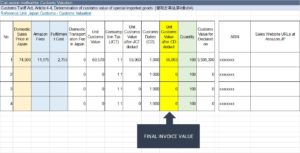
The import declaration value for Amazon FBA shipments is most commonly determined using an exceptional method—specifically under Article 4-4 of the Customs Tariff Law, by applying, on a mutatis mutandis basis, the domestic sales price determination method set out in Article 4-3, which involves deducting certain domestic costs (import duties and consumption tax, Amazon Referral Fee, Amazon FBA Fee, domestic transportation costs, etc.) from the domestic sales price. This calculation method is known as the Deductive Method.

Deductive Valuation Technique

The deductive method based on the domestic sales price follows the formula below:

Step-1)
Domestic Sales Price – Amazon Fees – Fulfillment Cost – Other Domestic Fees (e.g., Domestic Transport, Clearance charge)

For example, Sales Price 74,500 JPY – Miscellaneous Fees (11,175 JPY + 2,755 JPY) = 60,570 JPY

Step-2)
Divide the amount from Step 1 by 1.10 (including 10% Japan Consumption Tax), adjusted for the applicable customs duty rate

For example, 60,570 JPY ÷ 110% = 55,063 JPY

The 55,063 JPY from above is the import declaration price per product.


Required Screenshots as Evidence of Sales Price and Fees

Japan Customs requires sellers to provide clear evidence of the sales price and any deducted fees. The following documents are typically requested:


Evidence of Sales Price:  

1. Screenshot of the Amazon.JP Sales Website at [www.amazon.co.jp/dp/ASIN NUMBER]        

2. Screenshot from Inventory Management at the Amazon Seller Central 


Evidence of Amazon Fees (Referral Fees, Fulfillment Costs, etc.):  

1. Screenshot of the Revenue and Cost Simulator 


2. Cost Report:  

In some cases, you may also be required to submit the Fulfillment by Amazon Cost Report       

As your trusted Customs Procedures Attorneys (ACP) in Japan, ACP JAPAN is committed to meticulously preparing all requisite documentation and screenshots for the import declaration process. Depend on our skilled guidance to meet all your customs requirements.


Our ACP Service: The Best Solution for the Japan Importer of Record (IOR) and Exporter of Record (EOR)

ACP is an effective solution for addressing Importer of Record (IOR) and Exporter of Record (EOR) requirements in Japan. Through our ACP service, non-resident entities located outside Japan are able to import and export goods as Non-Resident IOR and EOR.

Below is an overview of our basic scope of work, together with a diagram illustrating the operational structure of the ACP service. Once ACP registration is completed, the non-resident entity can act as the Importer of Record (IOR) and Exporter of Record (EOR) in Japan.

Scope of Work – How We Can Assist

  • Consultation with Japan Customs to support successful ACP registration.
  • Liaison with relevant stakeholders, including freight forwarders and Japan Customs, to ensure the smooth and compliant import and export of goods.
  • Assistance in preparing and reviewing import and export clearance documentation.
  • Support in the calculation of customs value, in accordance with the Japan Customs Tariff Act.
  • Assistance with advance rulings on HS classification, customs valuation, and rules of origin.
  • Import compliance support for regulated products, including Domestic Administrator (sometimes referred to as “Domestic Representative”) Services under the Product Safety Acts (PSE/PSC) and food-related products regulated under the Food Sanitation Act.
  • Support for security export control, including list-based classification, catch-all control assessment, and assistance with export license applications to the Ministry of Economy, Trade and Industry (METI).
  • Record-keeping support in accordance with Article 95 of the Japan Customs Law.
  • Provision of professional trade and customs advisory services to address and resolve issues that may arise during import or export operations.

**Both import and export activities can benefit from the use of an ACP (Attorney for Customs Procedures). This support is applicable in scenarios where a non-resident acts as the Importer of Record (IOR) for imports and as the Exporter of Record (EOR) for exports.

Three Steps to Initiate Shipments Under the ACP Program:

  1. Quotation Review to Contract Conclusion: Upon receiving your contact details, we will promptly provide a quotation for your review.
  2. Commencing the Registration of ACP (Attorney for Customs Procedure) to Japan Customs: This process is generally completed in about two weeks.
  3. Initiation of First Shipment, Import/Export


Track Record – Attorney for Customs Procedures (ACP) Services

We have supported import and export operations in Japan for over 200 clients across more than 40 countries.